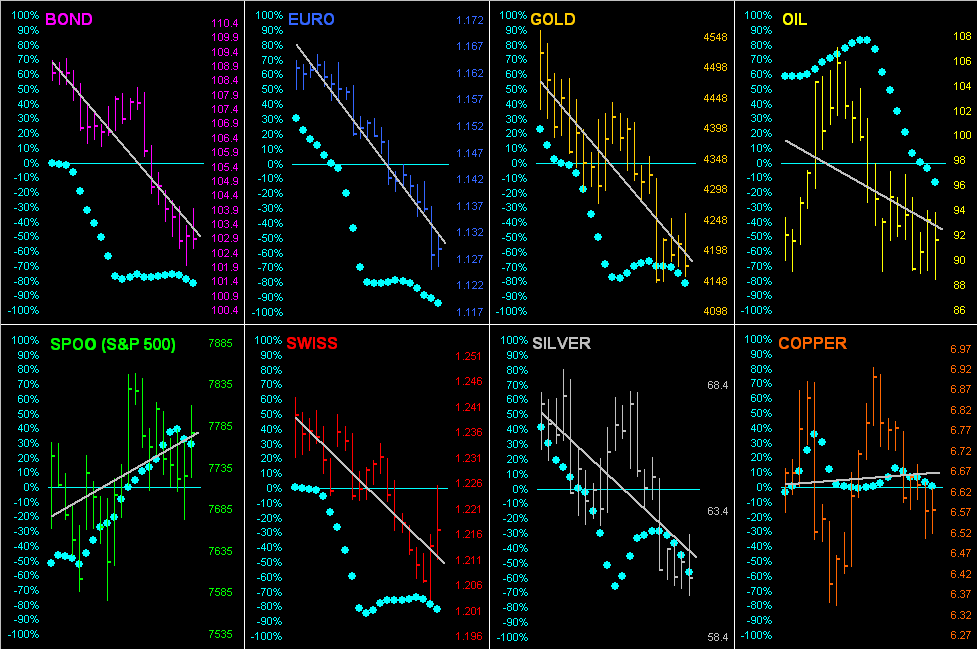
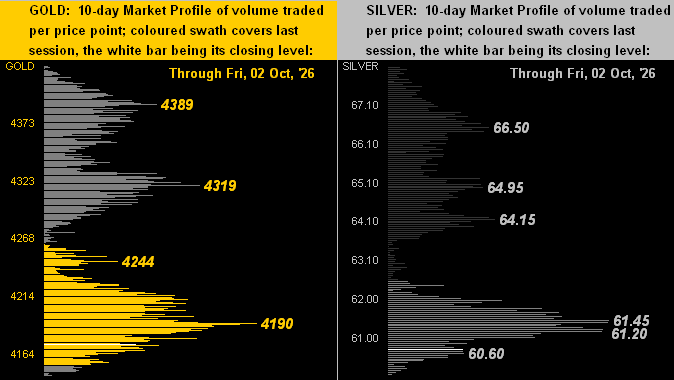
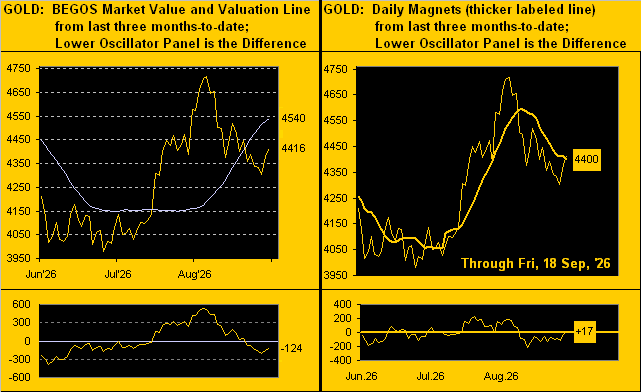
The Euro plus all three elements of the Metals Triumvirate are at present above their respective Neutral Zones for today; the other BEGOS Markets are within same, and session volatility is again mostly moderate, the notably exception still being Copper having already traced 120% of its EDTR (see Market Ranges). Gold has been getting some grip, certainly so today, as is Silver, which relative to the yellow metal had been falling behind the norm: more tomorrow in the 882nd consecutive Saturday edition of The Gold Update. Yesterday, the Bond — at least for the moment — reversed course to the upside, notably clearing volume-dominant Market Profile resistance at 102^22, (the current trade is at 102^27); for Market Rhythm pure swing consistency, mind the Bond’s 15mn Moneyflow. The Dollar Index having been above 102 during the week is retreating a bit today (currently 101.865). Per the S&P 500 MoneyFlow page, we are seeing wrinkle of weakness. And the Econ Baro wraps its week with October’s UofM Sentiment Survey.
 Mark
Mark
08 October 2026 – 08:46 Central Euro Time
Both the Bond and Silver are at present below today’s Neutral Zones, whilst above same are both Copper and Oil; session volatility for the BEGOS Market is mostly moderate, Copper exceptionally having already traded 107% of its EDTR (see Market Ranges). By Market Rhythms for pure swing consistency, the Top Three on 10-test basis are to date both Gold’s daily Price Oscillator and Parabolics, plus the non-BEGOS Yen’s 6hr MACD; for the 24-test basis they are both Oil’s 6hr Parabolics and 15mn Moneyflow, plus the Yen’s 4hr MACD. The risk-full yield of the S&P 500 is 1.070% vs. the risk-less yield of the 1yr T-Bill’s 4.420%. The Gold/Silver ratio now at 69.9x is the highest level since 03 August: Gold is attempting to gain grip, whereas Silver keeps slipping away, even as Copper is firming. Incoming metrics for the Econ Baro include August’s Wholesale Inventories.
07 October 2026 – 08:40 Central Euro Time
As mused yesterday given its potential trading range, the S&P 500 reached an all-time high at 7845: the “live” (futs-adj’d) P/E is 79.2x (or ex-CRWD ’tis 49.0x). Presently, we’ve yet again both the Euro and Swiss Franc below today’s Neutral Zones, as too are the Bond, Gold, Silver and Copper; BEGOS Markets’ session volatility is pushing toward moderate. Going ’round the Market Values horn for the five primary BEGOS components, we’ve (in real-time): the Bond -5^19 points “low” vis-à-vis its smooth valuation line, the Euro -0.026 points “low”, Gold -274 points “low”, Oil -1.61 points “low” and the Spoo +235 points “high”. Late in the session is the release of the FOMC Minutes from the 15/16 September meeting, plus for the Econ Baro, August’s Consumer Credit.
06 October 2026 – 08:39 Central Euro Time
As we saw ’round this time yesterday, both the Euro and Swiss Franc are again below today’s Neutral Zones; the balance of the BEGOS Markets are within same, and session volatility is light. Our best Market Rhythms for the Euro are the daily Price Oscillator and 2hr Moneyflow; for the Franc, they are the daily EMA and 2hr MACD. Oil yesterday slipped below volume-dominant Market Profile support at 92.90, and price slipped below its Market Magnet of 92.04, currently 88.78 is trading; our best Market Rhythms for Oil are the daily Parabolics and 8hr MACD. The all-time high for the S&P 500 remains that at 7817 from 13 August: however that is coming within range, as by Fair Value at this instant, the S&P would gap higher to 7794. The Econ Baro awaits August’s Trade Deficit.
05 October 2026 – 08:42 Central Euro Time
Into the new week we’ve at present the Euro, Swiss Franc and Oil below today’s Neutral Zones, whilst above same is Silver; BEGOS Markets’ volatility is moderate-to-robust, notably so for the Euro in having already traced 171% of its EDTR (see Market Ranges) ’tis said due to inflation and French fiscal concerns. The Gold Update confirms price’s weekly parabolic trend as having flipped to Short, yet not much downside is anticipated in eyeing 4000 as “The Floor”; currently 4180 is trading; again, Gold’s key Market Rhythms to mind are both the Price Oscillator and Parabolics on the daily chart. The S&P 500 MoneyFlow page is evidence of just how much dough is being thrown into the large-cap constituents. For the Econ Baro we’ve September’s ISM(Svc) Index. And Q3 Earnings Season gets underway through 20 November.
The Gold Update: No. 881 – (03 October 2026) – “Our Key Gold Trend Flips Short; Yet ‘The Floor’ of 4000 Is Support”
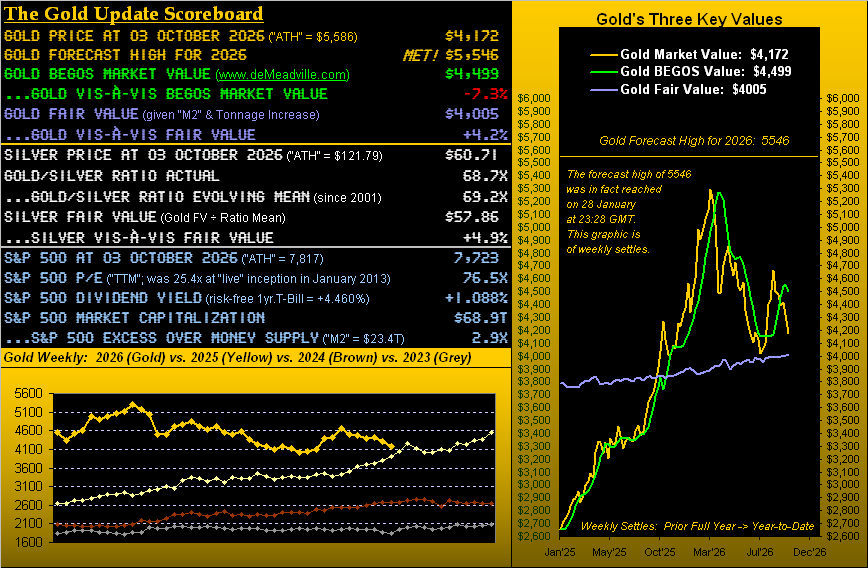
Having opened last week’s piece (“Still Lower Gold Ahead”) with “We honestly hope we’re wrong about this…”, unfortunately we were right. Barely had the ink from our Chinese-lacquered S.T. Dupont Gold-tipped fountain pen dried upon the final draft being submitted for publication, that the trading week commenced with Gold falling like a stone on Monday alone from 4321 to what would hold as the week’s low at 4143. Regardless, ’twas a single session intra-day loss of -178 points, (or -4.1%, eighth-worst year-to-date), as rather reluctantly read ahead by The Gold Update.

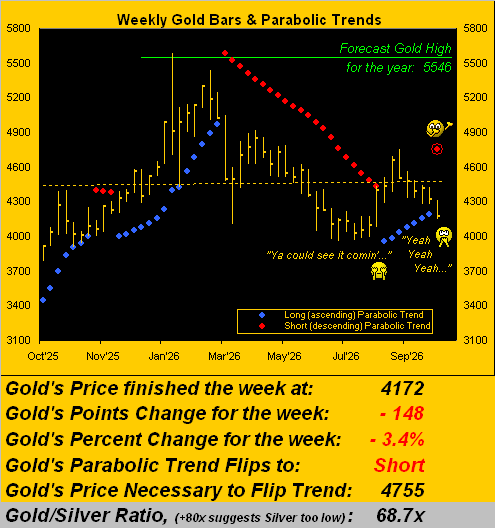
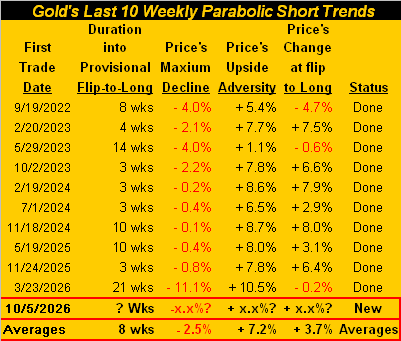
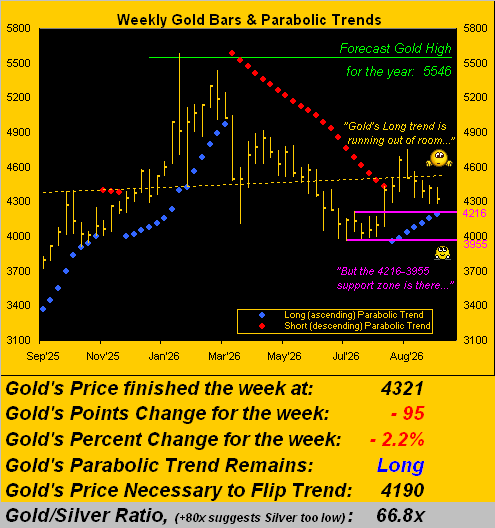
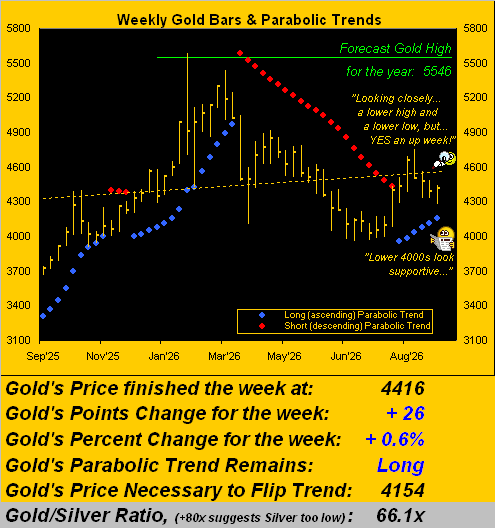
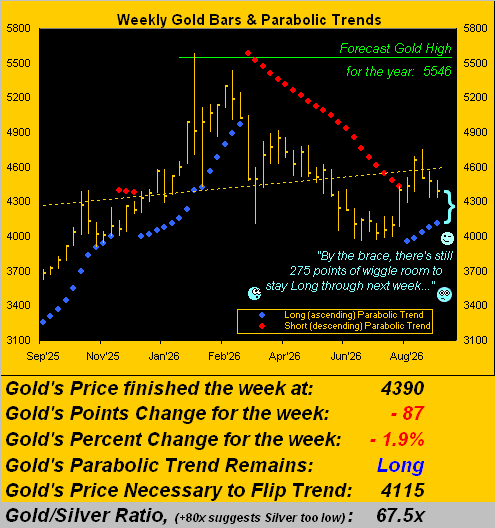
Followed came Tuesday’s Prescient Commentary stating “Gold’s weekly parabolic trend has provisionally flipped from Long-to-Short”, as further confirmed by yesterday’s (Friday’s) settle at 4172. ‘Twas not a beautiful thAng, but as you regular readers know, the flip had already been brewing through recent weeks. Here are the year-over-year weekly bars featuring the rightmost first red dot as encircled of the new parabolic Short trend:
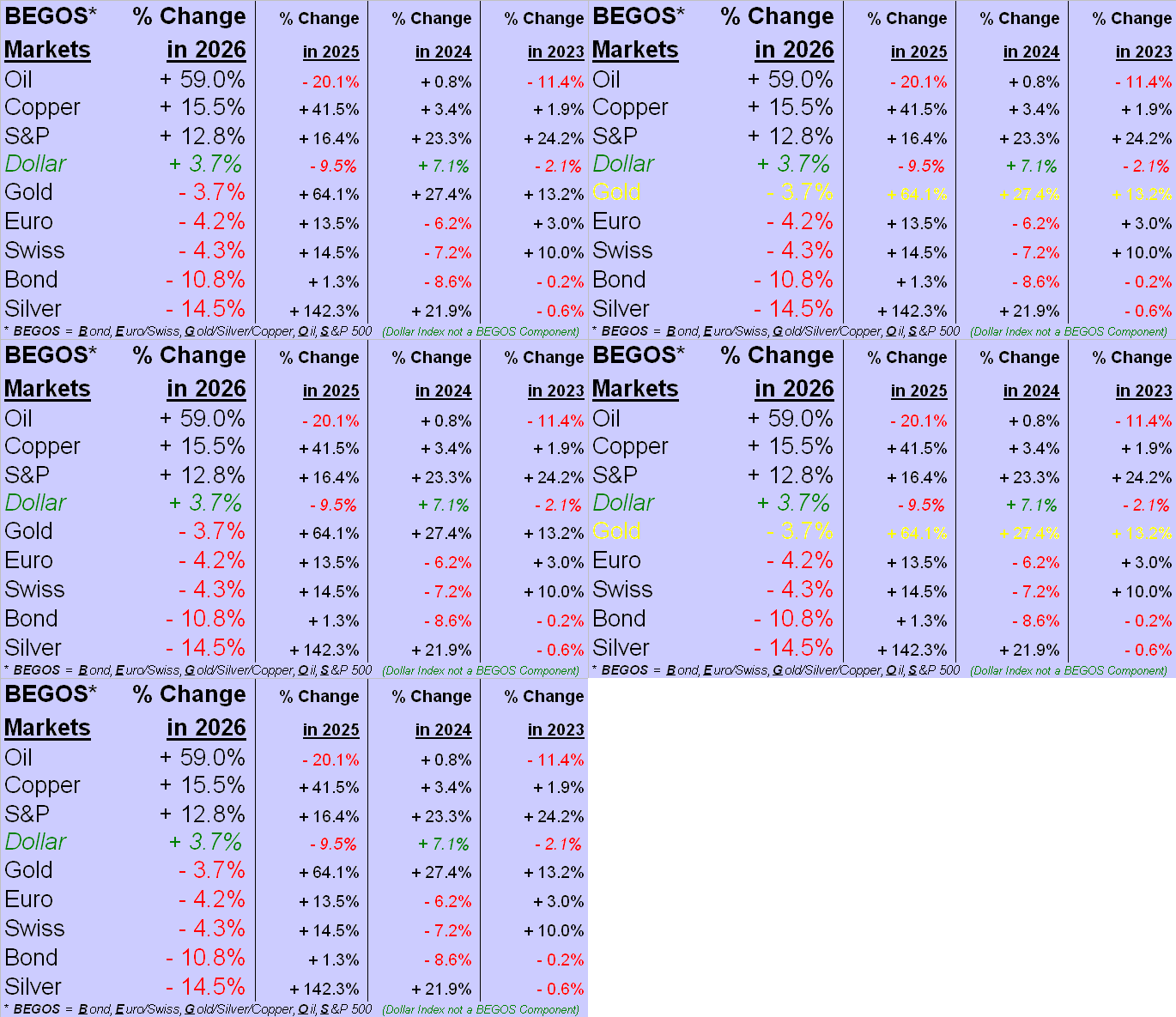
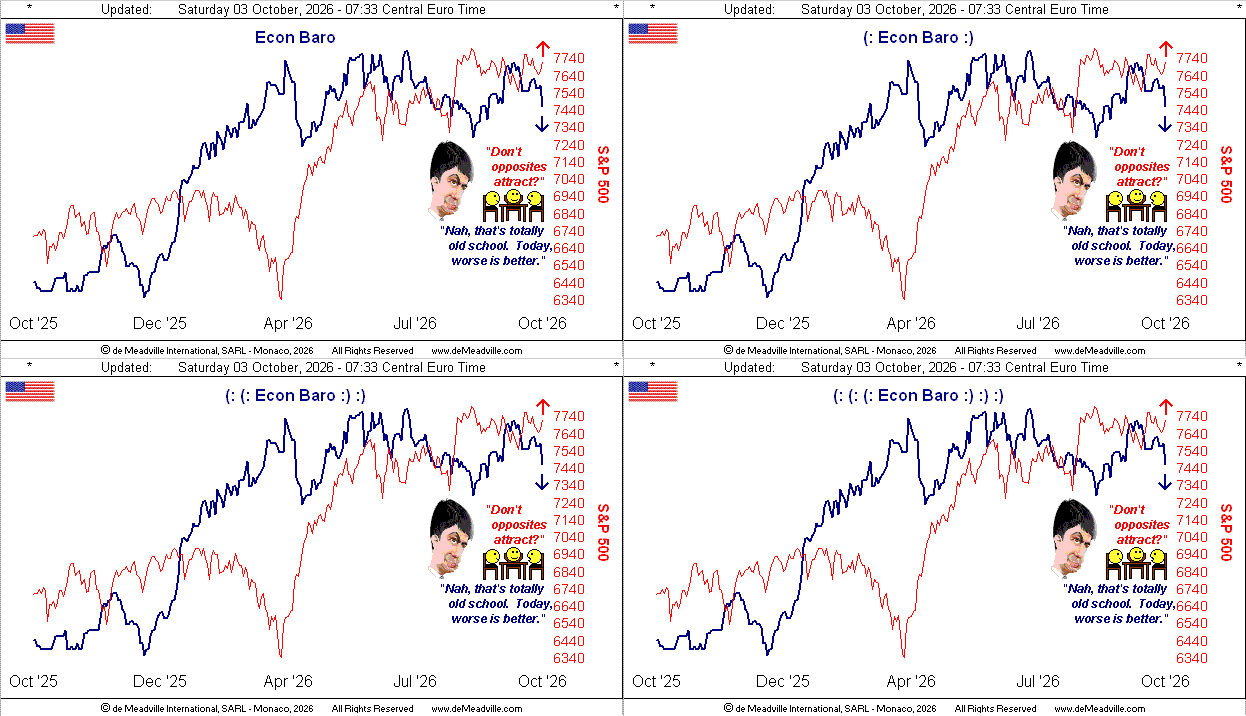
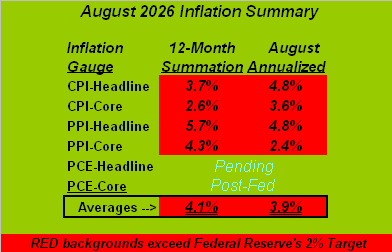
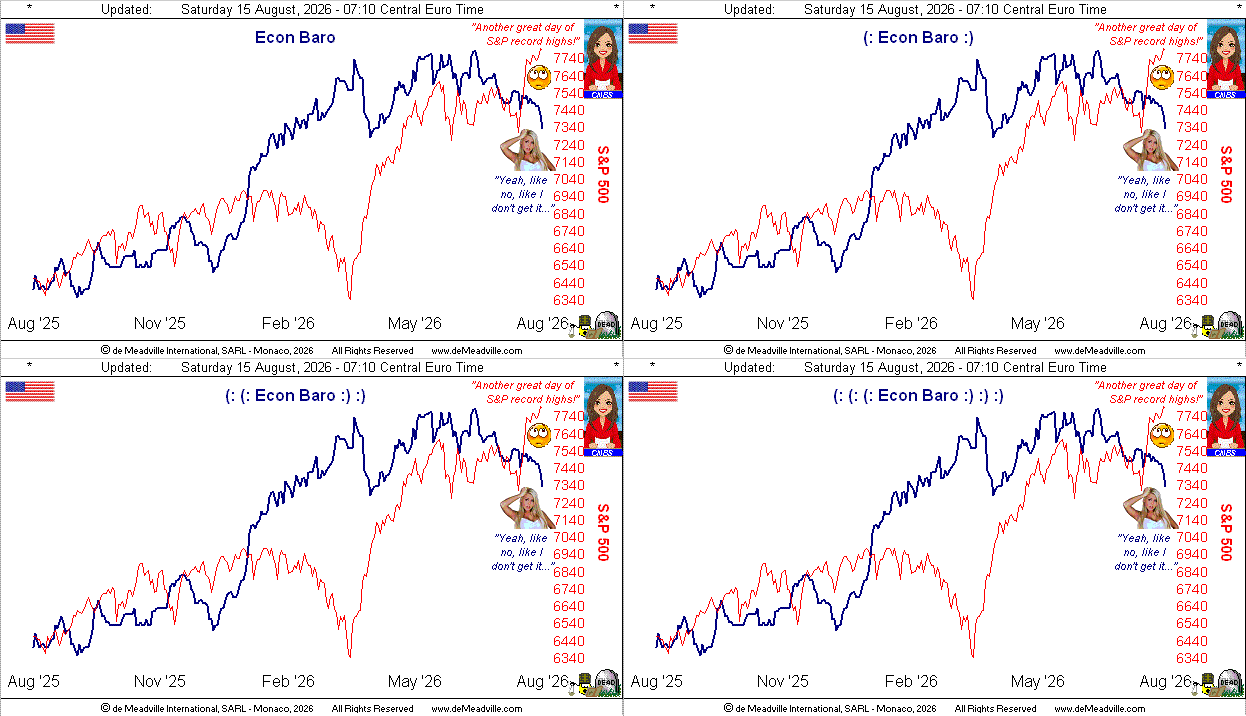
As to the StateSide economy, can it weather another Federal Open Market Committee vote to again nudge up its Bank’s FundsRate come the 28 October Policy Statement? Last week brought 16 metrics into the Economic Barometer, eight of which fared poorer per the prior period. The real data shocker for us was Personal Spending soaring in August by +0.9%, almost completely unsupported by Personal Income rising only +0.2%. “How’s that variable-rate credit card workin’ out for ya??” And per the Conference Board, September’s Consumer Confidence recorded its second-worst month-over-month drop since COVID during 2021. “Are you confident??” Gotta cue this one:  “Nobody Knows You When You’re Down and Out”–(Jimmie Cox, 1923). At least (as previously grasped), the S&P 500 apparently never goes down. Here’s the Baro:
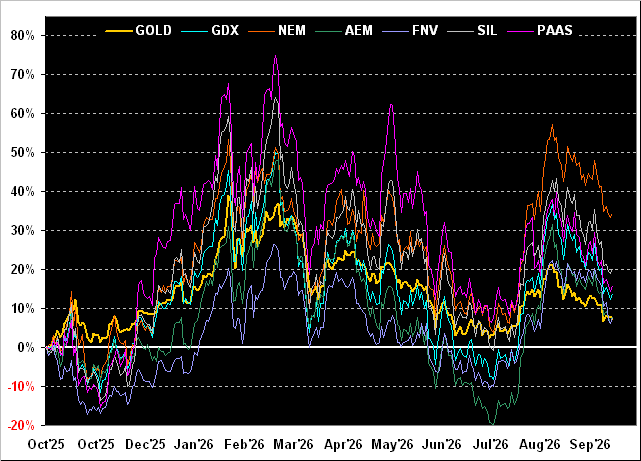
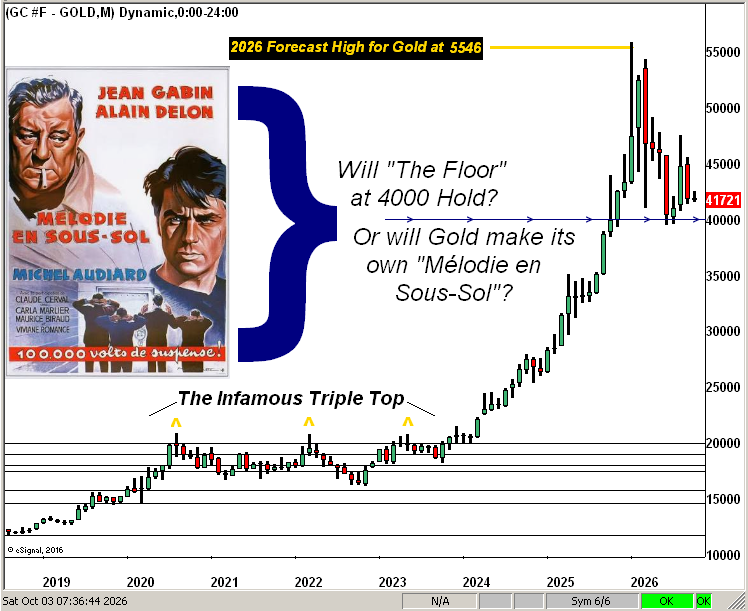
Thus — of which we’ve been wary through recent weeks — Gold’s weekly parabolic trend has flipped to Short, yet “The Floor” of 4000 is support and ’tis in range to get tested in the new week. Thereto, should Fair Value (4005) trade, ’tis always a brilliant opportunity to buy, (barring the StateSide money supply shrinking over time … impossible).

“Wow, is that Grace Kelly, mmb?
‘Tis a state secret, Squire. But as inevitably the Fed shall be forced to spin the printing tumblers to both pay down debt and bail out broker I.O.U. holders of S&P 500 (et alia) constituents, in turn we’ll see Gold fly high into the sky!
Cheers!
…m…
www.TheGoldUpdate.com
www.deMeadville.com
and now on “X”: @deMeadvillePro
02 October 2026 – 08:36 Central Euro Time
Presently, we’ve the Euro, Swiss Franc and Spoo all above today’s Neutral Zones; the balance of the BEGOS Markets are within same, and session volatility is again moderate, albeit noting that the Franc already has traced 120% of its EDTR (see Market Ranges); it remains to be seen if this is the start of an notable up move for the Franc and Euro as we’d anticipated a week ago: key to mind there are the “Baby Blues” of linreg consistency (see Market Trends); too, the Franc yesterday moved above volume-dominant Market Profile resistor of 1.2130, (current price 1.2163). Gold has stabilized following Monday’s demise, even as today brings confirmation of the weekly parabolic trend’s having flipped to Short: more of course in tomorrow’s 881st consecutive Saturday edition of The Gold Update. And the Econ Baro closes out its busy week with September’s Payrolls data, plus August’s Factory Orders.
01 October 2026 – 08:40 Central Euro Time
The Euro, Swiss Franc and Copper are all at present below today’s Neutral Zones; above same are Gold, Silver and the Spoo, and BEGOS Markets’ session volatility is moderate. Amongst the five primary BEGOS components, the best current correlation is positive between the Euro and Spoo. The S&P’s settle yesterday (7651.54) was a “Hobson Close” on the session’s low, market lore being that it shall move higher at the open, (which at this instant market to Fair Value would be a gain of +51 points). Looking at Market Rhythms for pure swing consistency, our Top Three on a 10-test basis are Gold’s daily Price Oscillator, the non-BEGOS Yen’s 6hr MACD (which provisionally at this writing is crossing to negative), and Oil’s 8hr MACD; on a 24-test basis, they are both Oil’s 6hr Parabolics and 4hr MACD, plus the Yen’s 4hr MACD. Silver yesterday traded down through its most volume-dominant Market Profile supporter of 61.20, however has regained that level thus far today. Incoming Econ Baro metrics include September’s ISM(Mfg) Index and August’s Construction Spending.
30 September 2026 – 08:34 Central Euro Time
The Euro is above its Neutral Zone for today, whilst below same is Copper; session volatility for the BEGOS Markets is expectedly light ahead of the busy incoming metrics load for the Econ Baro, namely: September’s ADP Employment data and Chi PMI, the final revision to Q2 GDP, plus August’s Personal Income/Spending and “Fed-favoured” PCE data here on the final trading day of Q3. Going ’round the Market Values horn for the five primary BEGOS components vis-à-vis their respective valuation lines, we’ve (in real-time) the Bond a full -6 points “low”, the Euro -0.031 points “low”, Gold -322 points “low, Oil +0.61 points “high” and the Spoo -17 points “low”; these multiple cases of “low” are indicative of recent Dollar strength. Oil (currently 89.78) yesterday slipped beneath volume-dominant Market Profile support at 92.20, whereas Copper (now 6.638) moved above like resistance at 6.620. We look for session volatility to ramp up post-PCE.
29 September 2026 – 08:45 Central Euro Time
Gold’s weekly parabolic trend has provisionally flipped from Long-to-Short, price yesterday falling by as much as -4.1% to 4143, the lowest level since 05 August; the new hurdle price to regain the Longside is 4755. Currently 4176, Gold as well as Copper are at present above today’s Neutral Zones; the Swiss Franc is below same, and BEGOS Markets’ session volatility is light. The recent “Baby Blues” (see Market Trends) Long signals for both the Swiss Franc and Euro have yet to produce gains given the war’s Oil/Dollar bid, the “Dixie” pushing back up above 101 as we’d last seen in June and July. The Spoo yesterday slid below its most volume-dominant Market Profile supporter of 7766, (current price 7745); still, the “live” P/E of the S&P 500 is a futs-adj’d 73.1x and the yield 1.092%; (that for the 1yr riskless T-Bill is 4.590%). The Econ Baro awaits Consumer Confidence for September.
28 September 2026 – 08:48 Central Euro Time
Into the new week, we’ve seven of the eight BEGOS Markets at present below their respective Neutral Zones for today; the sole component above same is Oil, and session volatility is moderate-to-robust. The Gold Update rather reluctantly cites “Still Lower Gold Ahead”, which clearly is the case at the moment, the current price of 4208 being -112 points: the weekly parabolic flip-to-Short level is 4190, and most broadly, Fair Value is 4001; in real-time, Gold is -344 points below its smooth valuation line (see Market Values); Gold’s best Market Rhythm for pure swing consistency is the daily Price Oscillator, or if seeking a per swing profit of 35 points, ’tis the daily Moneyflow. The Econ Baro, whilst quiet today, has a heavy load of incoming 16 metrics as the balance of the week unfolds, including on Wednesday the “Fed-favoured” PCE data.
The Gold Update: No. 880 – (26 September 2026) – “Still Lower Gold Ahead”
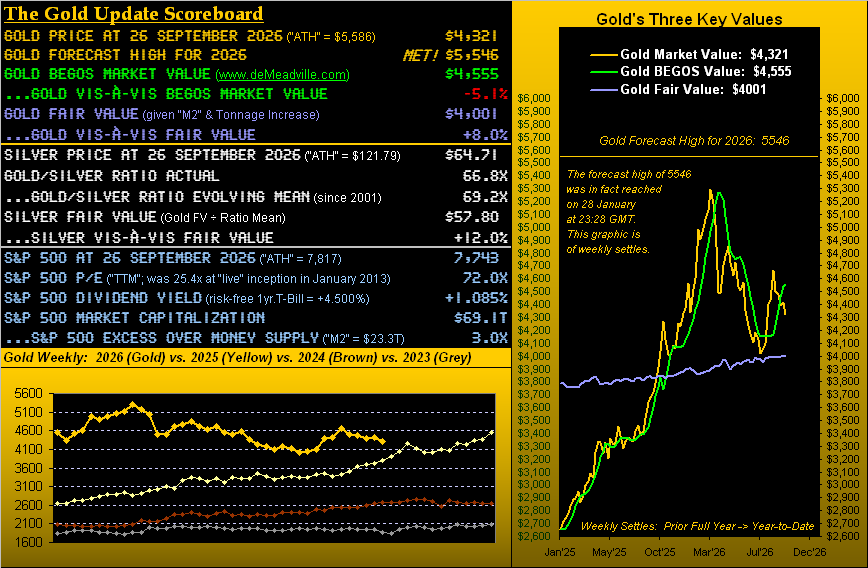
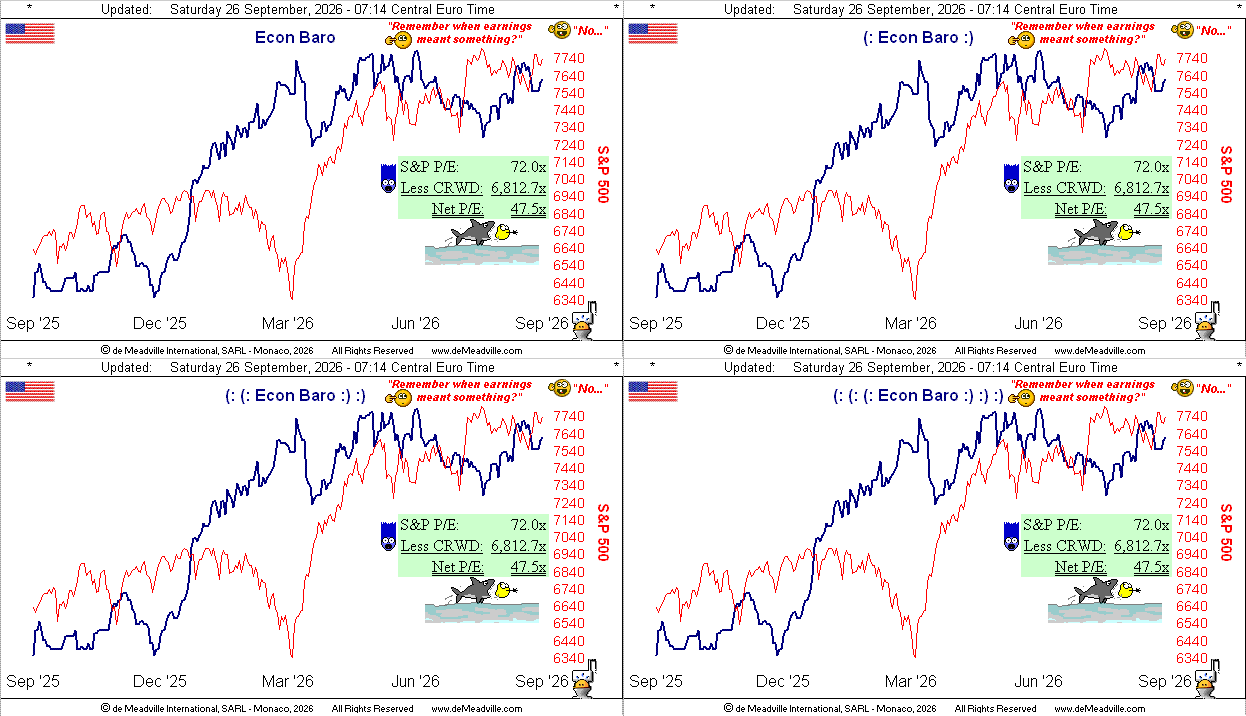
Thus, on rolleth The Investing Age of Stoopid. Over here, the pros we know are on the edge of their deck chairs waiting for the S&P to crash, whereas the under-40 crowd are chasing — well — Crowdstrike and the like.
Meanwhile from the “Cash Is King Dept.”, UBS opines that cash is a “poor” long-term investment as it yields less than 1%. Guess what also just barely yields 1%? The S&P 500 (per our opening Gold Scoreboard). So is the S&P thus, too, a “poor” investment? Remember (as we’ve on occasion mentioned): it took the S&P over 13 years from 2000 into 2013 to net a gain of just +2%. Not to worry, however: the once-mighty Barron’s opined this past Thursday that “Stocks Are Resilient, Fairly Priced, and Probably Getting Ready to Rally”. Let’s therefore wrap as we again update this old-timer:
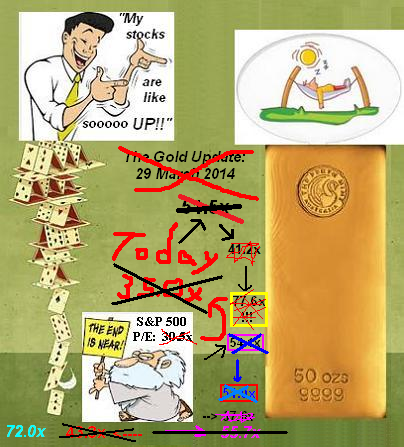
As we opened, hopefully we’re wrong about “Still Lower Gold Ahead”, albeit it can be tough to fight both the war and the Fed. But that said, make sure you’ve Gold as an investment stead!
Cheers!
…m…
www.TheGoldUpdate.com
www.deMeadville.com
and now on “X”: @deMeadvillePro
25 September 2026 – 08:42 Central Euro Time
Both the Bond and Spoo are at present above today’s Neutral Zones, whilst below same is Oil; BEGOS Markets’ session volatility is light-to-moderate. Gold is en route to completing its fourth down week in the last five, however not so much as to yet flip the weekly parabolic trend from Long to Short; still, there shan’t be much wiggle room remaining as we go into tomorrow’s 880th consecutive Saturday edition of The Gold Update. The Spoo (7777) has nearly returned up to its BEGOS Market Value (7812 in real-time); but the P/E of the S&P 500 itself is (ex-CRWD) 47.8x and the yield 1.082% vs. 4.510% on the “riskless” 1yr T-Bill; of note, FedFundsFuts are at present pricing in another +0.25% rate increase come the 28 October FOMC Policy Statement. And the Econ Baro wraps its limited week with the revision to September’s UofM Sentiment Survey and August’s Durable Orders.
24 September 2026 – 08:39 Central Euro Time
The Swiss Franc is at present the sole BEGOS Market above today’s Neutral Zone; below same are both Copper and the Spoo, and session volatility is light. As was the case for the Swiss Franc on Tuesday, the Euro yesterday confirmed its “Baby Blues” of linreg consistency (see Market Trends) having risen above the key -80% axis, suggestive of still higher levels near-term: currently 1.1427, we’re eying a run up into the 1.16s. By Market Rhythms for the Euro, pure swing consistency has been per the 6hr MACD; or if seeking a profit target per swing of 0.0144 points, the daily Price Oscillator; also, the Euro as a primary BEGOS component is (in real-time) -0.0362 points beneath its smooth valuation line (see Market Values). Incoming metrics for the Econ Baro include August’s New Home Sales and Q2’s Current Account Deficit.
23 September 2026 – 08:47 Central Euro Time
The Bond is presently above its Neutral Zone for today; below same are all the other BEGOS Markets, save for the Spoo, and session volatility is pushing toward moderate. Yesterday’s settles confirmed two “Baby Blues” (see Market Trends) signals: to the Long side ’tis for the Swiss Franc, the Blues having moved above the -80% axis; currently 1.2288, the signal suggests a move up into the 1.24s; conversely, Oil’s Blues falling below +80% elicited a move to the Short side: currently 89.38, the 85s reasonably may trade near-term, (the war of course being the wildcard); too, Oil has moved beneath its Market Magnet for the first time since 28 August. Oil’s best Market Rhythm by pure swing consistency is the 30mn Parabolics, or if seeking a target of 1.8 points/swing, the daily Parabolics. The Econ Baro kicks into late-week gear tomorrow.
22 September 2026 – 08:47 Central Euro Time
The Bond, Gold and Silver are all at present below today’s Neutral Zones, whilst above same is Oil; session volatility for the BEGOS Markets is light-to-moderate. Yesterday’s raucous rally in the S&P 500 (+1.5% or 114 points) ranks eighth-best (by %) year-to-date, in turn driving the “live” (futs-adj’d) P/E to 71.1x, (that of constituent CRWD alone being 6737.3x, without which the P/E would be 47.1x). Specific to the Spoo (which by its “continuous contract” has touched the all-time high of 7838), its best Market Rhythm for pure swing consistency is the 15mn MACD, whereas if seeking a profit target of 52 points per swing, ’tis the daily EMA. Meanwhile, Gold’s weak start to the week continues: currently 4357, price yesterday fell below volume-dominant Market Profile support at 4390 which, too, is its Market Magnet. As noted yesterday, the Econ Baro remains quiet until Thursday.
21 September 2026 – 08:42 Central Euro Time
Presently, both the Bond and Spoo are above today’s Neutral Zones, whilst below same are the Euro, Swiss Franc, Oil and Gold; BEGOS Markets’ volatility is pushing toward moderate. The Gold Update sees the weekly parabolic Long trend as having at least another week to run, albeit price needs a substantive move up to maintain our targeted notion of 4959 from five weeks ago at 4432 (indeed price having then made it to as high as 4755 only to now be down at 4385); the war remains the negative wildcard for the yellow metal. Gold’s best Market Rhythm for pure swing consistency is the daily Price Oscillator, or if seeking a profit objective of 35 points per swing, the daily Moneyflow (as is listed on the current Market Rhythms page). This is a very subdued week for the Econ Baro with a scant five incoming metrics scheduled, none of which appear until Thursday.
The Gold Update: No. 879 – (19 September 2026) – “Gold Records (Barely) an Up Week in Maintaining the Long Streak”
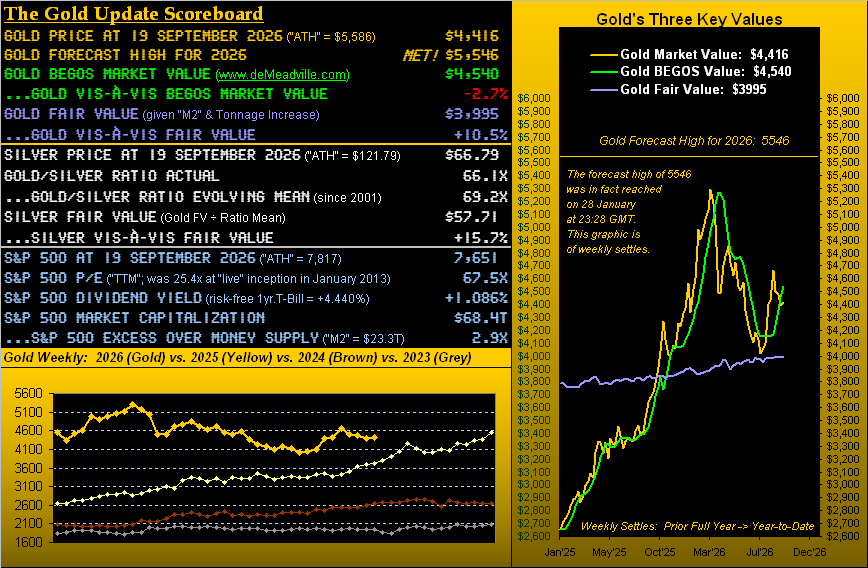
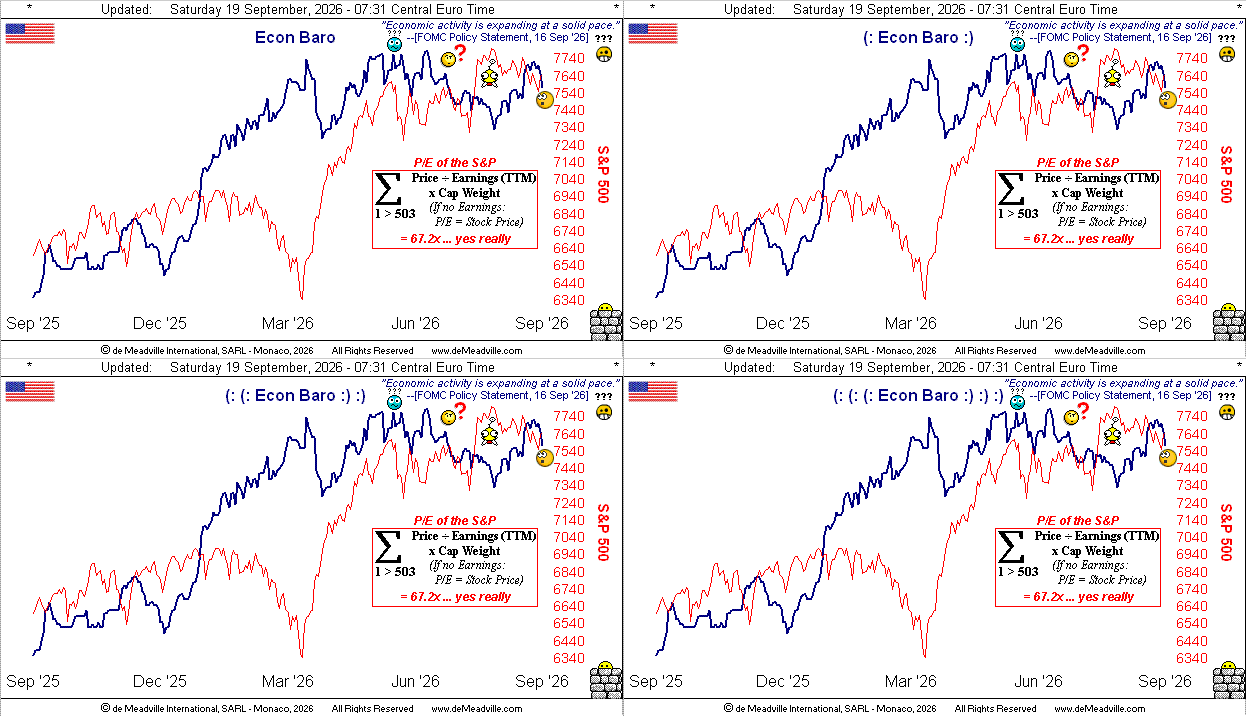
For this past week alone, 15 metrics came into the Econ Baro of which only five improved period-over-period. (Again given the Fed’s being “behind the curve”, they likely shan’t figure that out until their 27/28 October meeting). Nevertheless stated, August’s Retail Sales were the best of the incoming bunch; but Building Permits slowed and July’s Business Inventories suffered their biggest month-over-month backup swing since those from COVID-stricken December 2021, (meaning product on balance wasn’t moving).
“And that S&P P/E of 67.2x is nuts, mmb!”
Squire, we yet again queried “AI” (“Assembled Inaccuracy”) with the exact formula, and per usual, it came up with an excuse, this time being: “I have investigated the available data sources, but I cannot yet produce a reliable calculation for all 503 constituents as of September 18, 2026.” (For those of you scoring at home, all you need is an Excel worksheet incorporating for each constituent its current price, trailing 12-month earnings, and current market-capitalization weighting within the S&P. ‘Tis so easy, a WestPalmBeacher can do it … well, maybe not…)

Of greater import, is a better up week for Gold about to unfold? Either way, ‘tis Gold one wants to hold!
Cheers!
…m…
www.TheGoldUpdate.com
www.deMeadville.com
and now on “X”: @deMeadvillePro
18 September 2026 – 08:47 Central Euro Time
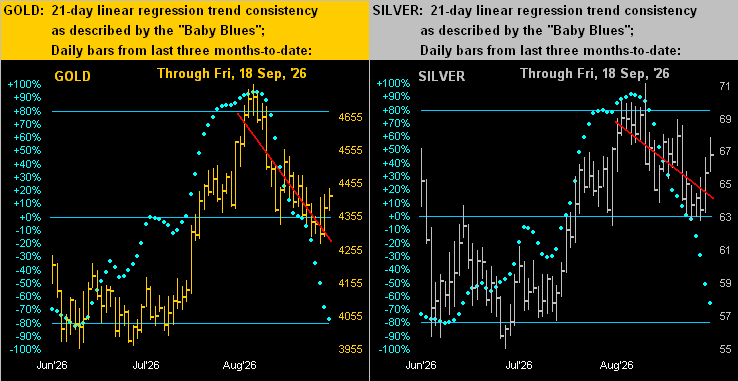
Gold, Silver and the Spoo are all presently above today’s Neutral Zones, whilst below same is Oil: the latter’s cac volume has rolled from October into that for November with a discount of -4.60 points. Session volatility for the BEGOS Markets is mostly moderate. Gold (currently 4433) can end its three-down-weeks’ streak with a settle today above 4390 such that the ongoing weekly parabolic Long trend would still have some breathing room: more tomorrow in the 879th consecutive Saturday edition of The Gold Update. The P/E of the S&P 500 is at a (futs-adj’d) stratospheric 69.1x, although eliminating CRWD from the Index reduces that to “only” 45.1x; (too, S&P shall rebalance the Index prior to Monday’s opening in welcoming three new constituents with three being removed). For the Econ Baro today we’ve August’s IndProd/CapUtil, plus the month’s Leading (i.e. “lagging”) Indicators.
17 September 2026 – 08:45 Central Euro Time
The FOMC rightly raised its Bank’s Funds Rate, the vote unanimous even as our notion was they’d perhaps wait for the August “Fed-favoured” PCE data (due 30 September). So now “post-Fed” we’ve at present seven of the eight BEGOS Markets above today’s Neutral Zones, the sole component below same being Oil as ’tis “said” the USA/IRN war may be winding down; session volatility is moderate. In going ’round the horn for the five primary BEGOS Markets in real-time we’ve: the Bond -4^22 points “low” vis-à-vis its smooth valuation line, the Euro -0.033 points “low”, Gold -183 points “low”, Oil +16.04 points “high”, and the Spoo -201 points “low”. Today’s incoming metrics for the Econ Baro include September’s Philly Fed Index, plus August’s Housing Starts/Permits and Pending Home Sales.
16 September 2026 – 08:41 Central Euro Time
Currently, we’ve both Gold and Silver above today’s Neutral Zones, whilst below same is Oil; BEGOS Market’s volatility is light. As to correlations amongst the five primary BEGOS components, the best is still positive between Gold and the Spoo. Our Top Three best Market Rhythms for pure swing consistency are (on a 10-test basis) Silver’s 15mn Parabolics, the Spoo’s 15mn Moneyflow and Gold’s 30mn MACD, whereas (on a 24-test basis) they are Oil’s 6hr Parabolics, again the Spoo’s 15mn Moneyflow, and Gold’s 6hr MACD. The Econ Baro looks to September’s NAHB Housing Index, August’s Retail Sales and Ex/Im Prices, plus July’s Business Inventories. The FOMC’s Policy Statement (18:00 GMT) is widely expected to see the FedFunds interest rate target range raised from 3.50%-3.75% to 3.75%-4.00%: we’ve been on record for some two years that it need be raised, however The Gold Update states the Committee shall stand pat pending August’s “Fed-favoured” PCE data due 30 September. Either way, expect extreme post-Statement volatility into the balance of the session.
15 September 2026 – 08:42 Central Euro Time
Cac volume for the Spoo has rolled from September into that for December with +67 points of premium; the Spoo at present (7672) is below today’s Neutral Zone, as are the Bond, Euro and Swiss Franc; Oil is above same, and session volatility for the BEGOS Markets is pushing toward moderate. By its Market Profile, the Spoo’s most dominant overhead resistor (basis December) is 7711, and price has fallen back beneath its Market Magnet; the Spoo’s best current Market Rhythm for pure swing consistency is the 15mn Moneyflow. As widely reported, the 10yr-T-Note yield returned to 5.000% for the first time since 20 July 2007, following which from October the S&P 500 embarked on the second of two -50% corrections century-to-date. The Econ Baro awaits September’s NY State Empire Index.
14 September 2026 – 08:39 Central Euro Time
Not surprisingly, given the Saudi pipeline disruption, Oil gapped up to the commence the session and is above today’s Neutral Zone, whilst the Spoo gapped down and is below its Neutral Zone as too are the Euro, Swiss Franc and Copper; BEGOS Markets’ volatility is moderate, the Euro notably having traced 107% of its EDTR (see Market Ranges). The Gold Update points to the weekly parabolic trend as still Long, but that it may be in jeopardy by month’s end should the Dollar be getting the bid to purchase Oil. By Market Trends, six of the eight BEGOS components are now in negative linreg, the two positive exceptions being (of course) Oil and (barely) Copper. Oil’s best Market Rhythm for pure swing consistency is the 6hr Parabolics, or if seeking a profit target, the 12-Hour MACD which achieved at least 35 full points (both Long and Short) through nine of the past ten crossovers beginning back on 06 May. Nothing is due today for the Econ Baro with 15 metrics scheduled into the balance of the week. The FOMC Policy Statement comes Wednesday: we reason in The Gold Update “no change” albeit consensus (and rightly so) is for a 25bp FedFunds rate hike.
The Gold Update: No. 878 – (12 September 2026) – “Is Gold’s Weekly Long Trend Nearing Its End?”
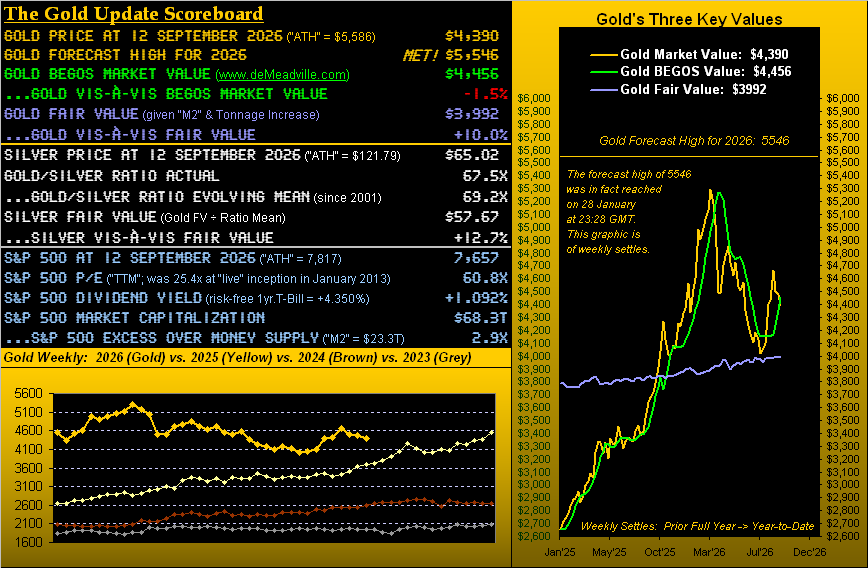
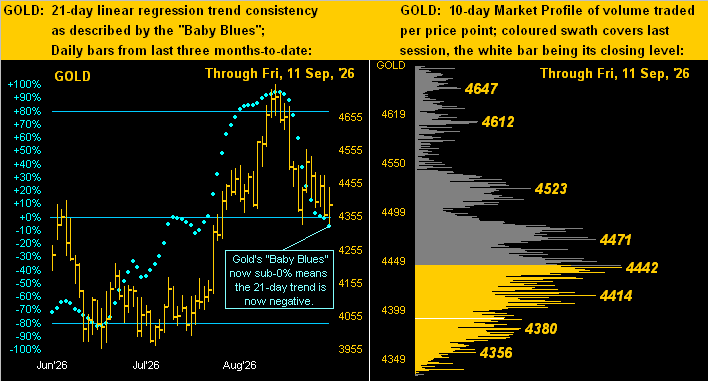
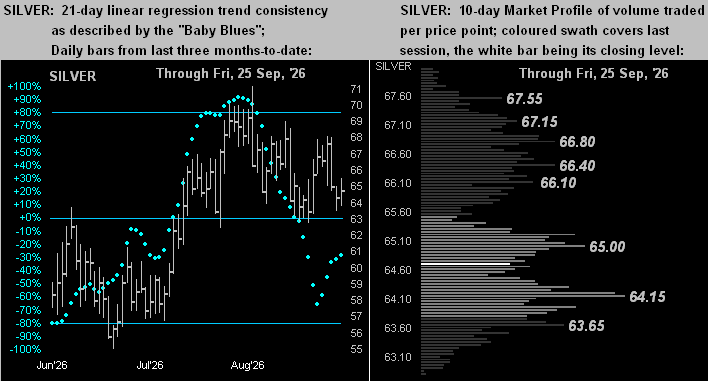
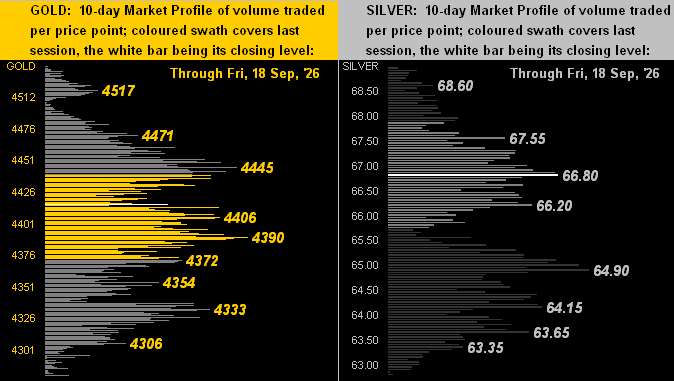
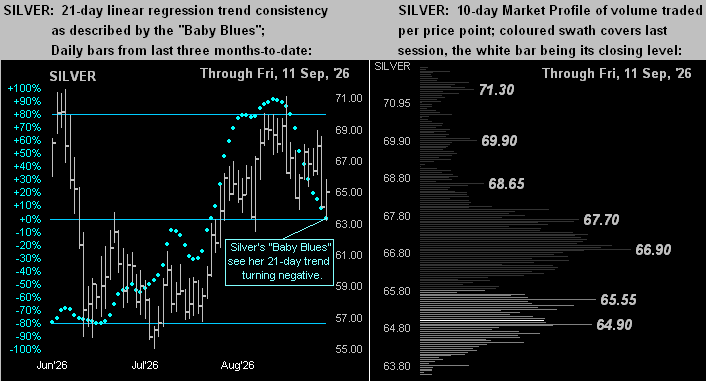
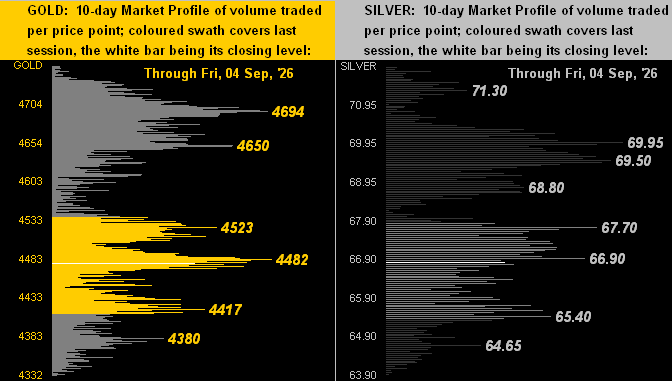
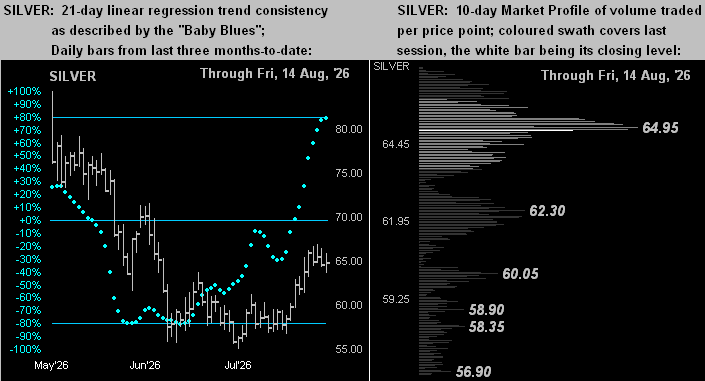
Such is the similar state of Silver, having settled the week at 65.02. Her “Baby Blues” (below left) are on the cusp of the regression trend rotating from positive to negative. By her Profile (below right), volume resistance runs up into the 66s and 67s. Jim Diamond’s ’86 hit “Hi Ho Silver” is instead appearing rather “Lowdown”–(Chicago, ’71). C’mon, ol’ Sister Silver…
Toward our wrap, here’s the Stack:
The Gold Stack (continuous contract pricing):
Gold’s All-Time Intra-Day High: 5586 (29 January 2026)
2026’s High: 5586 (29 January)
Gold’s All-Time Closing High: 5411 (28 January 2026)
10-Session “volume-weighted” average price magnet: 4463
Gold’s BEGOS Market Value (from our opening “Scoreboard”): 4456
Trading Resistance: nearby Market Profile notables: 4414 / 4442 / 4471
Gold Currently: 4390, (expected daily trading range [“EDTR”]: 115 points)
Trading Support: nearby Market Profile notables: 4380 / 4356
10-Session directional range: down to 4331 (from 4678) = -347 points or -7.4%
The 300-Day Moving Average: 4269 and rising
The Weekly Parabolic Price to flip Short: 4115
Gold’s Fair Value per Dollar Debasement, (from our opening “Scoreboard”): 3992
2026’s Low: 3955 (30 June)
The 2000’s Triple-Top: 2089 (07 Aug ’20); 2079 (08 Mar’22); 2085 (04 May ’23)
The Gateway to 2000: 1900+
The Final Frontier: 1800-1900
The Northern Front: 1800-1750
On Maneuvers: 1750-1579
The Floor: 1579-1466
Le Sous-sol: Sub-1466
The Support Shelf: 1454-1434
Base Camp: 1377
The 1360s Double-Top: 1369 in Apr ’18 preceded by 1362 in Sep ’17
Neverland: The Whiny 1290s
The Box: 1280-1240
And thus we close with just the briefest of questions: Has the S&P crashed yet? Just asking.
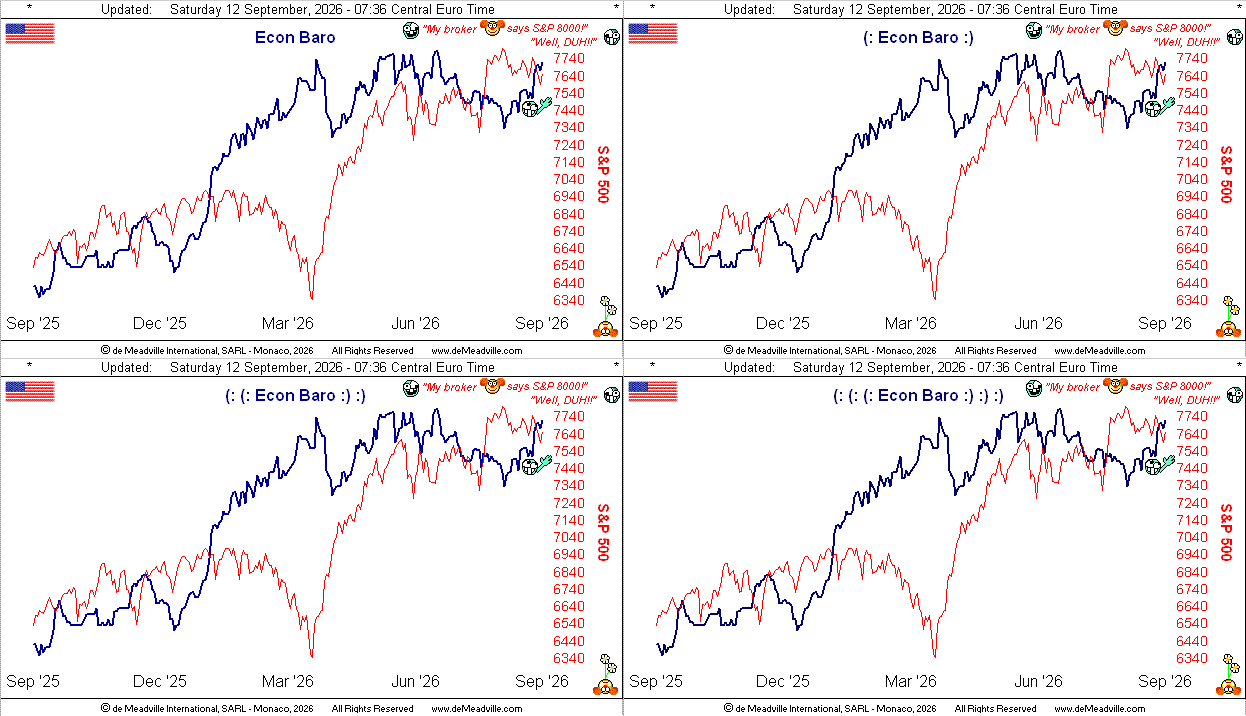
As noted in the Econ Baro graphic, “S&P 8000” has been bandied about, notably at very highly-visible investment banks due to (as we quote from “AI“) “strong corporate earnings”. If earnings are so “strong”, then why at this writing is the price/earnings ratio of the S&P 500 (trailing 12-months basis) at 60.8x? (For those of you scoring at home, that is 4x the “acceptable high” of 15x taught in portfolio theory).
“Yeah, mmb, but if you take out just CrowdStrike, it drops to 44.1x.”
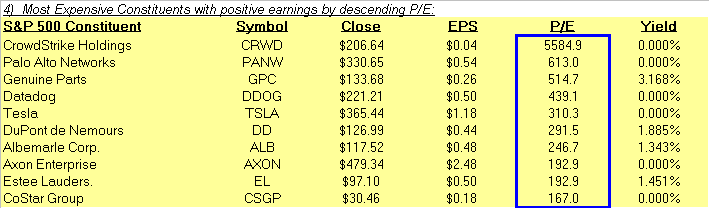
Squire, ’tis a good point as that company’s P/E settled the week at 5,584.9x, its market capitalization of $211.3B ranking 54th of the 503 constituents comprising the S&P; (or for you WestPalmBeachers down there: paying $206.64 for a stock that earns $0.04 per share is the equivalent of paying $5,584.90 for something that earns $1.00. “Got CRWD?” We hope not).
Indeed, from the deMeadville Valuation & Rankings page, here are our Top Ten goofball P/Es right now:
Sleeping well with those “strong corporate earnings”?
Lower Gold perhaps in our stead, make sure yours is your bed!

Cheers!
…m…
www.TheGoldUpdate.com
www.deMeadville.com
and now on “X”: @deMeadvillePro
11 September 2026 – 08:47 Central Euro Time
Into the 25th anniversary of “9/11” we’ve Gold, Copper and the Spoo all at present above today’s Neutral Zones, whilst Oil is below same; session volatility for the BEGOS Markets is moderate. By Market Trends, Gold’s falling “Baby Blues” yesterday confirmed the linreg’s rotation from positive to negative; price appears poised to record a third straight down week within the overall weekly parabolic Long trend: more on that in tomorrow’s 878th consecutive Saturday edition of The Gold Update. Copper’s -4.8% net loss yesterday ranks third-worst year-to-date; Silver’s drop of -5.7% was its worst day since 24 June (-6.73%). The “live” (futs-adj’d) P/E of the S&P 500 is 61.4x, albeit removing CRWD reduces that to “only” 44.3x, (still triple that taught as “high” in portfolio theory); and the “risk-full” yield is 1.097% vs. the “risk-less” 4.280% on the 1yr T-Bill. The Econ Baro looks to August’s CPI and Treasury Budget, as well as September’s UofM Sentiment Survey.
10 September 2026 – 08:38 Central Euro Time
Both the Swiss Franc and Spoo are presently above today’s Neutral Zones, whilst below same is Oil; BEGOS Market’s volatility is light. Yesterday, each of the Euro, Gold and Silver moved above their most volume-dominant Market Profile resistors, albeit the Bond dropped below that which had been support. Such noted, Gold in real-time (as anticipated earlier this week) finds its 21-day linreg having rotated to negative (see Market Trends); that for Silver, the Euro and Swiss Franc remain only marginally positive, even as the Dollar has been weakening across the last several trading days; and over these next two trading days, cac volume for the Currencies shall be moving from September into that for December. Today’s incoming Econ Baro metrics include August’s PPI and Existing Home Sales, plus July’s Wholesale Inventories.
09 September 2026 – 08:38 Central Euro Time
The Euro, Swiss Franc, Gold and Silver are presently above today’s Neutral Zones; the balance of the BEGOS Markets are within same, and session volatility is light-to-moderate. Both the Euro and Copper yesterday moved back above their Market Magnets, suggestive of higher levels near-term; moving below its Magnet was the Spoo, its next volume-dominant supporter being 7644 should 7681 fall away into a down day, (see Market Profiles). Gold and the Spoo continue to maintain our best correlation (positive) amongst the five primary BEGOS components. Gold’s top Market Rhythm for pure swing consistency is (on a 10-test basis) its daily price Oscillator and (on a 24-test basis) its 6hr MACD; for the Spoo ’tis the 2hr Parabolics by both bases. Ahead of inflation data both tomorrow and Friday, nothing is due today for the Econ Baro.
08 September 2026 – 08:35 Central Euro Time
The two-day session continues for the BEGOS Markets, now with the Euro, Swiss Franc, Copper and Oil above their respective Neutral Zones for today; below same are both Gold and the Spoo, and overall session volatility has expanded to mostly robust. In going ’round the horn of the five primary BEGOS components by their Market Values, we’ve (in real-time) the Bond -3^20 points “low” vis-à-vis its smooth valuation line, the Euro -0.017 points “low”, Gold +63 points “high”, Oil +9.85 points “high” and the Spoo -130 points “low”. At Market Trends, the “Baby Blues” of linreg consistency continue dropping for both Gold and Silver, albeit not (yet) below their 0% axes: recall for Gold’s weekly parabolic Long trend we’re seeking 4900, the high thus far being 4755 prior to the more recent selling, (price now 4447, yet only mildly lower for the week thus far). Late in the session comes July’s Consumer Credit for the Econ Baro.
07 September 2026 – 08:44 Central Euro Time
‘Tis a two-day Tuesday-settlement session for the BEGOS Markets; given the StateSide holiday, trading halts begin today from 17:00 GMT (with resumption as usual at 22:00 GMT). At present, Oil is above the session’s Neutral Zone, whilst below same is Gold; volatility is expectedly light. The Gold Update suggests should price put in a third consecutive down week that the weekly parabolic Long trend may soon be approaching an end, (although for this week, a flip to Short were 4074 to trade is well out of expected range); currently 4441, Gold’s most volume-dominant overhead resistor is 4482; too in real-time, price is +60 points above its smooth valuation line (see Market Values); and by Market Trends, we may see Gold’s 21-day linreg rotate to negative by week’s end. ‘Tis “inflation week” for the Econ Baro, the August PPI due Thursday and the CPI come Friday.
The Gold Update: No. 877 – (05 September 2026) – “Gold’s Recent Rally is Weakening … But an Up Week Can Right It”
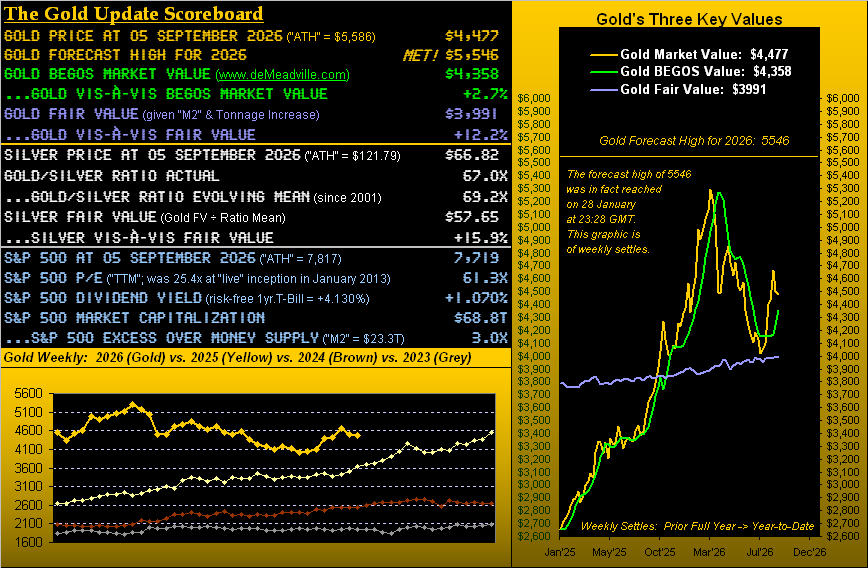
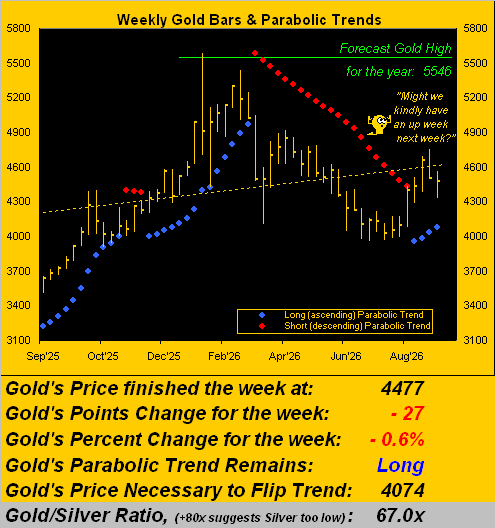
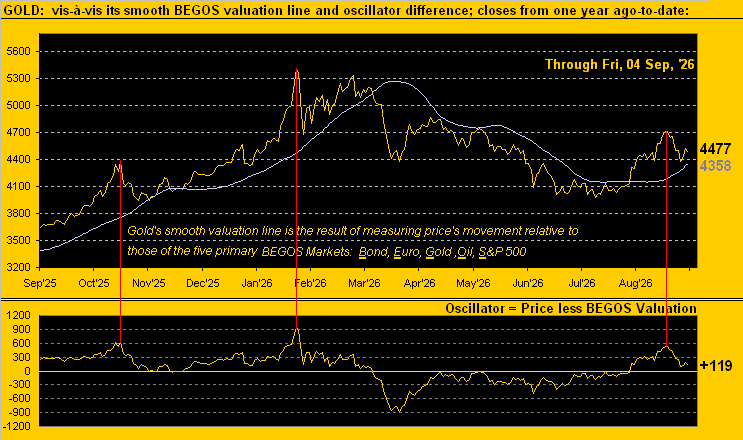
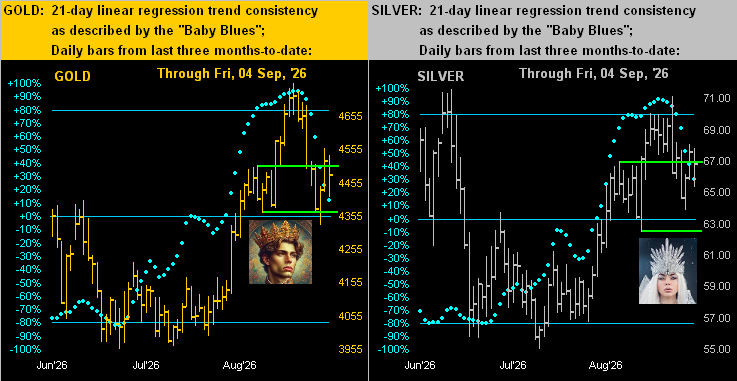
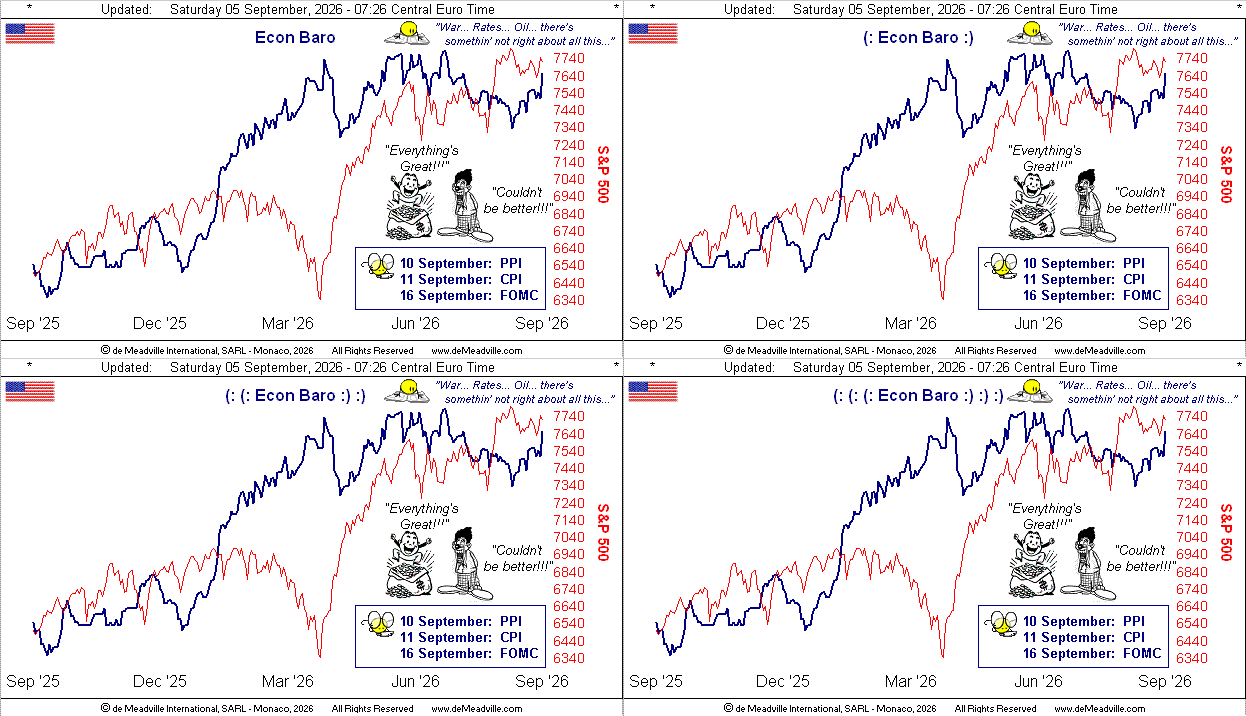
To close, as herein put forth a week ago, we’re not predicting an imminent crash for the S&P 500, albeit ’tis “crash season” and the “earningless n’ yieldless” Index is wildly overdue for one. In updating our numbers from a year ago, the first 25 Septembers thus far this century — when combined — amount to a -30.9% decline for the S&P, even as October tends hold the dubious distinctions of Black Tuesday (’29), Black Monday (’87) and (within the FinCrisis) Black Wednesday (’08). Then, too, there’s ol’ Black Swanee. When might he come floating by?

Make sure you’ve Gold when the rest go bye-bye!
Cheers!
…m…
www.TheGoldUpdate.com
www.deMeadville.com
and now on “X”: @deMeadvillePro
04 September 2026 – 08:31 Central Euro Time
The Spoo is presently the sole BEGOS Market outside (above) today’s Neutral Zone; session volatility is light. Support has held well for the precious metals this week; that stated, by Market Trends, the “Baby Blues” of linreg consistency continue to fall for both Gold and Silver as their respective uptrends weaken; more tomorrow, of course, in the 877th consecutive Saturday edition of The Gold Update. Yesterday was a firm day across all eight BEGOS Markets: of note therein with respect to Market Profiles, each of the Euro, Swiss Franc, Copper and Spoo moved above what been their most volume-dominant overhead resistors; too, the Spoo recovered above its Market Magnet. The Econ Baro raps its week with August’s Payrolls data as StateSide stocks move into the Labor Day Weekend, (the BEGOS Markets nonetheless trading an abbreviated Monday session for Tuesday settlement).
03 September 2026 – 08:39 Central Euro Time
The Euro, Swiss Franc and Gold are all presently above today’s Neutral Zones; below same is Oil, and session volatility for the BEGOS Markets is again moderate. By Market Rhythms, our Top Three for pure swing consistency are (on the 10-test run) the Bond’s 4hr Parabolics, Oil’s 1hr Parabolics, and Gold’s daily Moneyflow; too, (on the 24-test run) are Gold’s 1hr Moneyflow, Oil’s 6hr Parabolics and Copper’s 1hr MACD. The Spoo yesterday made another marginal one-month low at 7619: currently 7675, there is volume-dominant Market Profile support at 7644, with resistance running from 7686 up to 7698; and by its BEGOS Market Value, the Spoo is (in real-time) -129 points below its smooth valuation line (itself 7805). Today’s incoming Econ Baro metrics include August’s ISM(Svc) Index, July’s Trade Deficit, and the revision to Q2’s Productivity and Unit Labor Costs.
02 September 2026 – 08:45 Central Euro Time
The Euro, Swiss Franc and Spoo are all at present below their respective Neutral Zones for today; BEGOS Markets’ volatility is moderate. Amongst the five primary BEGOS components, the best correlation is positive between Gold and the Spoo; the latter yesterday moved beneath its Market Profile volume-dominant support of 7698, falling further to 7622, a one-month low. Opposingly, the 3mo T-Bill’s annualized yield reach a one-month high of 3.778%; (that for the S&P 500 is 1.094%). Also yesterday, both the Bond and Copper slipped beneath their respective Market Magnets, indicative of still lower price levels near-term. By Market Trends, Oil is the sole component for which the “Baby Blues” of linreg consistency are rising. The Econ Baro looks to August’s ADP Employment data and July’s Factory Orders. Then late in the session comes the Fed’s Tan Tome.
01 September 2026 – 08:40 Central Euro Time
The Bond, Euro and Swiss Franc are at present below today’s Neutral Zones; the rest of the BEGOS Markets are within same, and volatility is mostly light. Our notion a month ago of the Bond reaching up to 112 never materialized in this rather confusing wake of the Bessent/Warsh indicatives: price reached no higher than 110^16 and currently is 108^10, which by its BEGOS Market Value is (in real-time) -3^23 points below its smooth valuation line (itself at 112^01); too, the Bond yesterday fell below is volume-dominant Market Profile support of 109^16; the Bond’s best market Rhythm for pure swing consistency on a 10-test basis is the 4hr Parabolics; on the 24-test basis ’tis the 1hr Parabolics; the underlying product’s yield is 5.249%. For the Econ Baro we’ve August’s ISM(Mfg) Index and July’s Construction Spending.
31 August 2026 – 08:40 Central Euro Time
Both Copper and Oil are starting the week at present above today’s Neutral Zones; the Spoo is below same, and session volatility for the BEGOS Markets is moderate. The Gold Update sees price’s weekly parabolic Long trend as firm, albeit we point to some near-term anticipated weakness: already today for both Gold and Silver, the “Baby Blues” of linreg consistency (see Market Trends) have dropped below their respective +80% axis, suggestive of lower price levels; Gold’s support zone spans from 4509 down to 4366, and that for Silver from 66.98 down to 62.45; Gold by its BEGOS Market Value, (in real-time) is +255 points above the smooth valuation line. As well, we are entering (not predicting) “Crash Season” for the S&P 500, (see The Gold Update). Too, in having rebalanced the S&P’s shares, our “live” P/E is again above 60x (futs-adj’d 61.4x at this instant). The Econ Baro has nothing due today, with 13 incoming metrics through the balance of the week.
The Gold Update: No. 876 – (29 August 2026) – “For Gold We Favour Adhesion into S&P Crash Season”
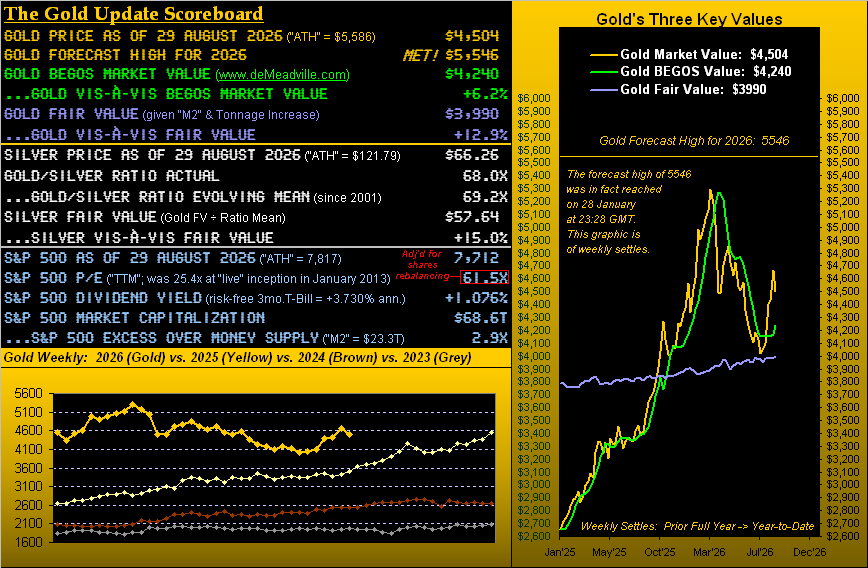
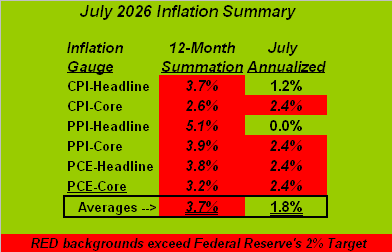
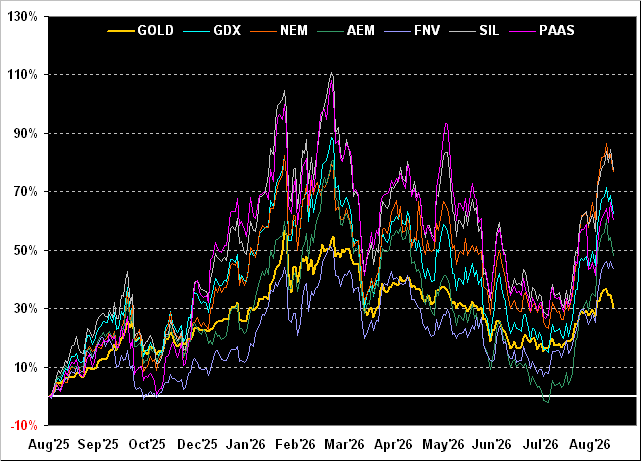
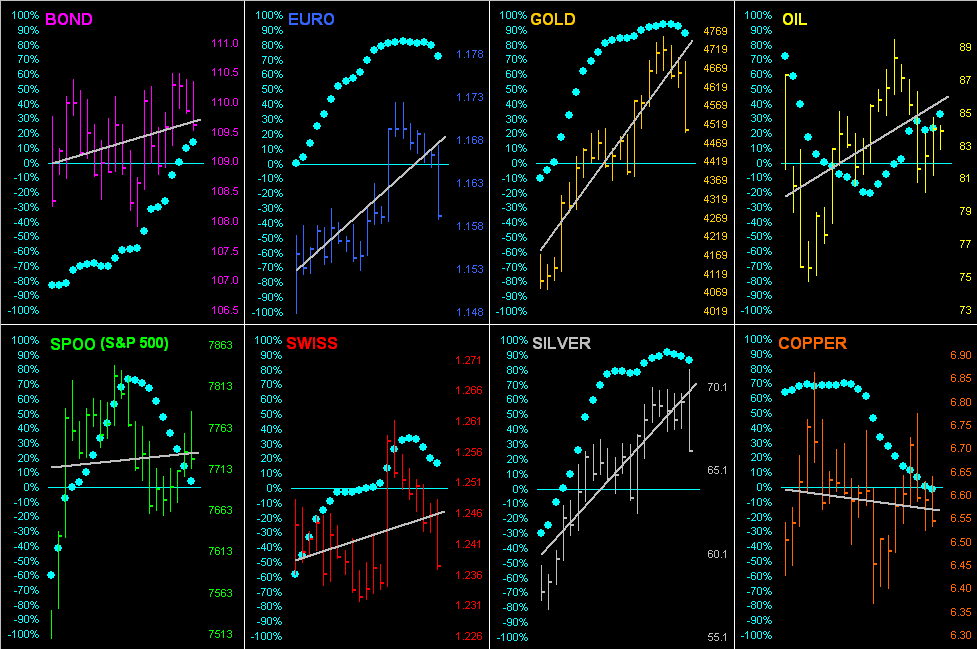
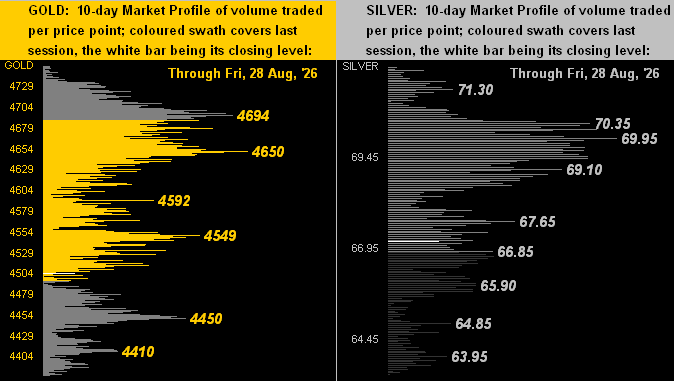
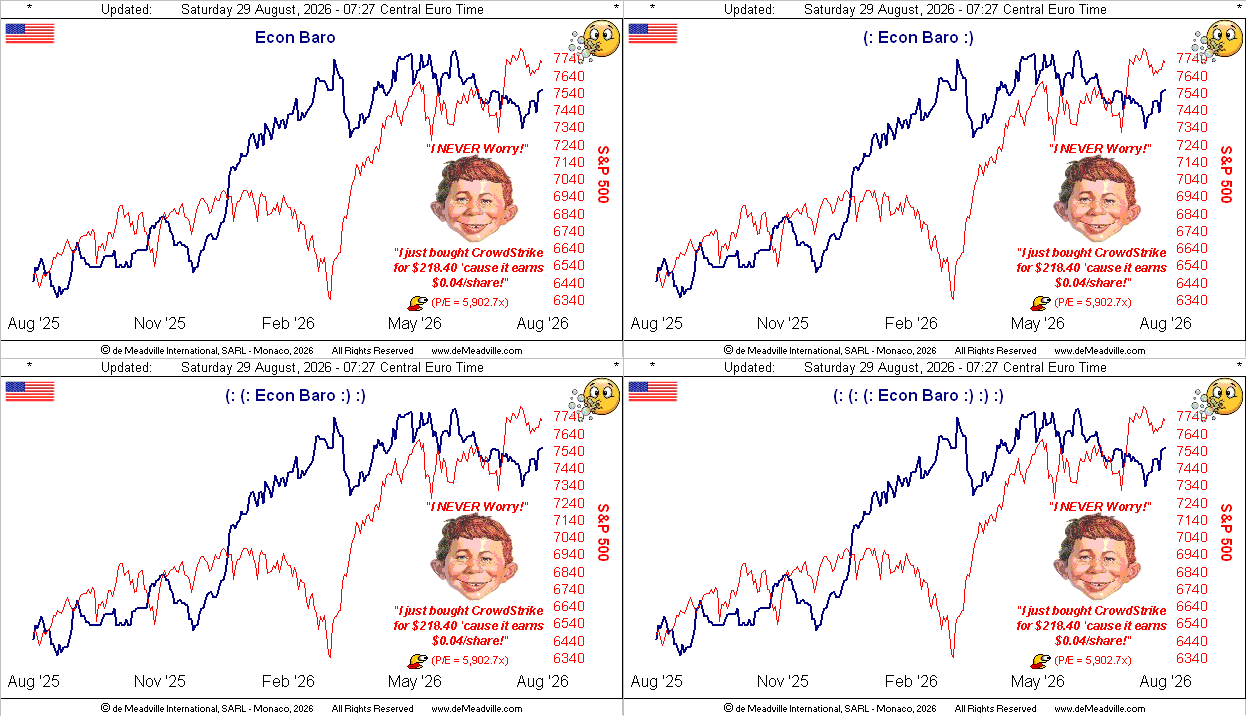
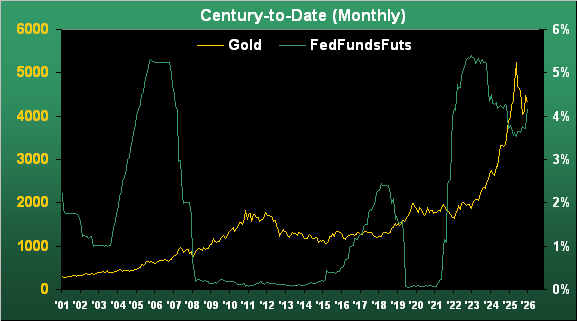
So whilst the herd blows bubbles as the S&P itself bubbles, let’s instead return to something of substance: Gold by its monthly structure so far this decade. Oh to be sure, Gold went through a stage of bubbling earlier this year in reaching the All-Time High of 5586 (29 January) — then +44% above Fair Value — only to thereby return, (as you’ll herein recall), come 24 June.
Regardless, as currencies have come and gone over the centuries, throughout there’s always been Gold: good ol’ Gold! Again, it has had periodic bubbles; but they’ve been relatively “Tiny Bubbles” –[’66] compared to those of Dollar debasement, debt and (understatement) S&P. Here’s the structure graphic, the rightmost candle showing an on-balance strong August, (and albeit with one trading day still to go), Gold’s best net month (+8.8% even in accounting for Friday’s demise) since February (+9.6%). You tell ’em in Golden style there, Don!
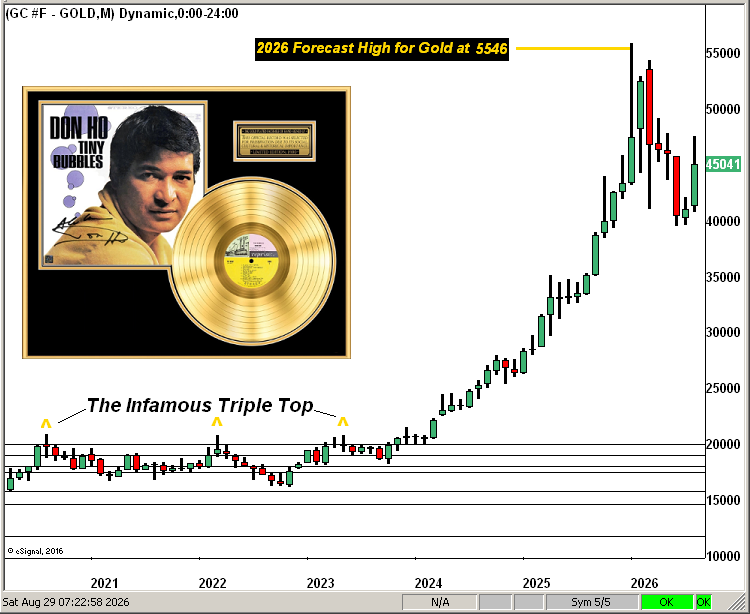
To sum it up, a bit more near-term Gold slippage is what we envisage, but hardly enough to flip the broader-based weekly parabolic from Long to back to Short: ‘twould entail from here a further fall of some -10%, whereas we’re instead keenly eyeing the 4900s to trade on this overall upside run.
‘Course, that in the following context would be modest. Given (per the opening Scoreboard) the ratio of the S&P 500’s market capitalization/liquid money supply being 2.9x, plus the ever-expansive insolvency of the U.S. Treasury, we provide this calculation, with which you can impress your friends at next weekend’s StateSide Labor Day BBQs:
Gold today: $4,504/oz. (Fair Value $3,990/oz.);
“Print” $45.5T to make S&P investors “whole” were the Index liquidated today;
and
“Print” $40.1T to make the U.S. Treasury “whole” were its debt paid down today;
…a little drumroll please…
Resultant Fair Value for Gold: $18,365/oz.
Or, as aforestated:

Adhere to Gold!
Cheers!
…m…
www.TheGoldUpdate.com
www.deMeadville.com
and now on “X”: @deMeadvillePro
28 August 2026 – 08:41 Central Euro Time
Oil is the sole BEGOS Market at present outside (below) its Neutral Zone for today; volatility for the session is again light. Yesterday, the Euro’s “Baby Blues” of linreg consistency (see Market Trends) confirmed having slipped below their key +80% axis: currently 1.1655, we’d watch for the Euro to test near-term the underlying 1.1628-1.1580 zone. Looking at Market Rhythms for pure swing consistency, our Top Three currently are (on a 10-test basis) Gold’s daily Moneyflow, Oil’s 4hr MACD and Copper’s 2hr Parabolics; too, (on a 24-test basis) they are Copper’s 15mn Parabolics and both Oil’s 15mn Parabolics and 6hr Parabolics. Gold is mildly net down for the week, although very comfortably within its recently established weekly parabolic Long trend: more tomorrow in the 876th consecutive Saturday edition of The Gold Update. The Econ Baro finishes its week with August’s Chi PMI and the usual revision to the UofM Sentiment Survey. And FedChair Warsh makes the annual KC Fed address in Jackson Hole.
27 August 2026 – 08:37 Central Euro Time
Presently, all eight BEGOS Markets are within their respective Neutral Zones for today, and session volatility is light. Both the Swiss Franc and Copper have slipped below their Market Magnets, suggestive of still lower prices near-term. Cac volumes are rolling today from September into December for both the Bond (at a -0^16 discount) and Silver (at at +0.800 premium) . By Market Values (in real-time) for the five primary BEGOS components: the Bond (basis December) is -2^18 points “low” vis-à-vis its smooth valuation line, the Euro -0.006 points “low”, Gold +441 points “high”, Oil -2.11 points “low” and the Spoo -22 points “low”. The “live” (futs-adj’d) P/E of the S&P 500 is 42.8x and the yield 1.085%, whereas that for the one-year T-Bill is 4.010%. The sole metric today for the Econ Baro is the prior week’s Initial Jobless Claims.
26 August 2026 – 08:33 Central Euro Time
The Euro and Gold are presently below today’s Neutral Zones, whilst above same is Copper: the latter’s cac volume is rolling today from September into December (with a +0.1000 premium); session volatility for the BEGOS Markets is light-to-moderate. Copper yesterday broke above volume-dominant Market Profile support at 6.7100 (basis December, price currently 6.8610). Following our bearish bias yesterday for Oil, price has since notably dropped from 84.22 (at our post) to as low as 80.08, essentially through the stated structural support zone; price also has passed below its BEGOS Market Value, below what had been volume-dominant support at 8230, and down through the Market Magnet of 83.88. For the Spoo, its price compression is evident by having traced a full EDTR (see Market Ranges) but once across the past three weeks, even as the EDTR has declined during that period from 107 to 65 for today. ‘Tis a key day for the Econ Baro encompassing the first revision to Q2 GDP, plus Durable Orders for July along with Personal Income/Spending and the month’s “Fed-Favoured” PCE data.
25 August 2026 – 08:44 Central Euro Time
Oil is presently below today’s Neutral Zone, whilst above same is the Spoo; amongst the five primary BEGOS Markets, those two continue to have the best correlation, which is negative; overall session volatility is moderate. Oil (84.22) yesterday slipped beneath its most volume-dominant Market Profile support level of 85.00, and in real-time Oil’s 12hr MACD (which is its best Market Rhythm per our Oil page) is crossing to negative: the last five such Short crossovers have each minimally produced (given hindsight) downside profit of $4k/cac within an average duration of some three weeks; structural support for Oil appears to run from 84.61 to 80.09; still, Oil’s 21-day linreg remains positive with its “Baby Blues” of trend consistency rising, (see Market Trends). The Econ Baro awaits August’s Consumer Confidence and July’s New Home Sales.
24 August 2026 – 08:46 Central Euro Time
The week begins finding at present both the Bond and Gold above today’s Neutral Zones, whilst below same are both Oil and the Spoo; session volatility for the BEGOS Markets is light-to-moderate. The Gold Update accounts for price’s push given the StateSide Treasury’s accelerating longer-term debt repurchasing; today’s high thus far of 4717 is Gold’s best level since14 May. Q2 Earnings Season has concluded finding 79% of reporting S&P 500 constituents having beaten their Q2 bottom lines of a year ago: that ranks second-best across the past 12 reporting quarters; the fly in the ointment remains the “live” P/E of 43.1x suggestive of at least a -40% “correction” simply to bring valuation into reasonable line with earnings. Nothing is due today for the Econ Baro, with 11 incoming metrics scheduled through the balance of the week.
The Gold Update: No. 875 – (22 August 2026) – “Gold and Other Bits Get the Contra-Buck Bid”
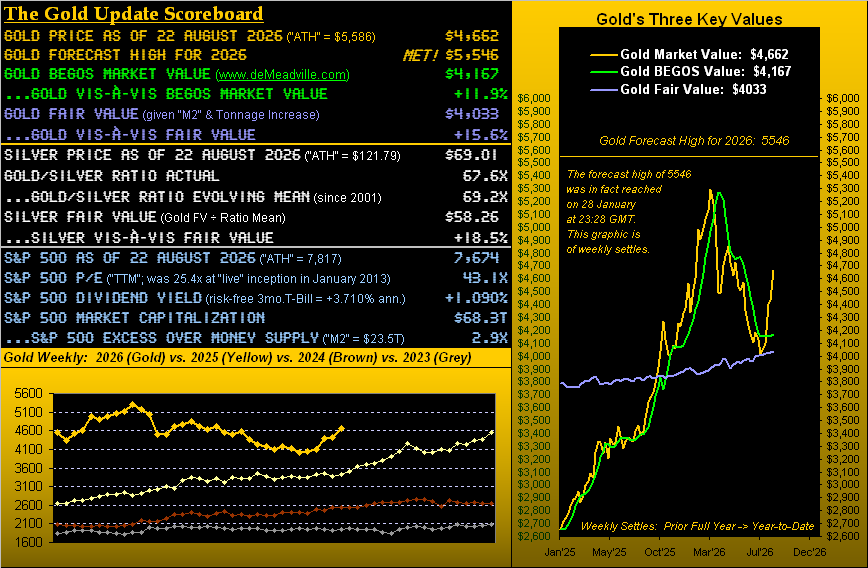
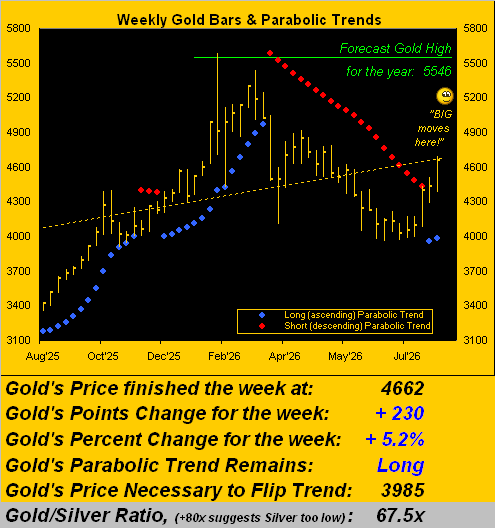
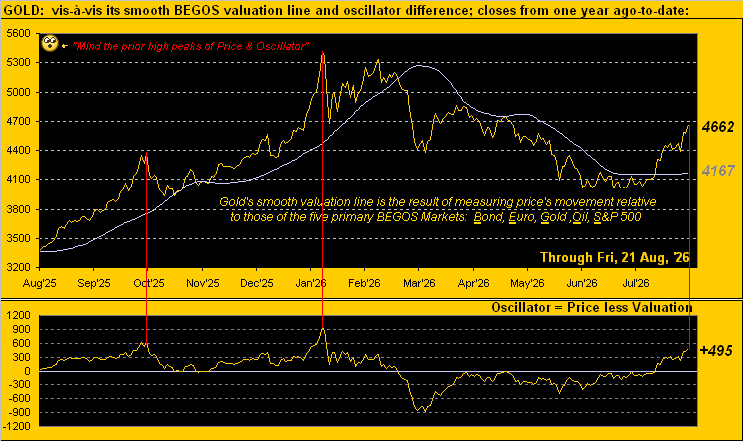
What can stem Gold’s recent robust uptrend? Two non-technical factors come to mind:
- Next week’s array of 11 incoming metrics for the Economic Barometer includes the “Fed-favoured” Personal Consumption Expenditures for July. Consensus calls for increases (+0.1% headline, +0.2% core) over those of a completely benign June, such uptrend then perhaps becoming construed as Gold negative. And there are a number of saber-rattling Federal Reserve officials of late with an eye towards raising The Bank’s Funds rate. Let’s see how FedHead Kevin “The Warrior” Warsh this next Friday addresses any notion in Jackson Hole of jacking up rates.
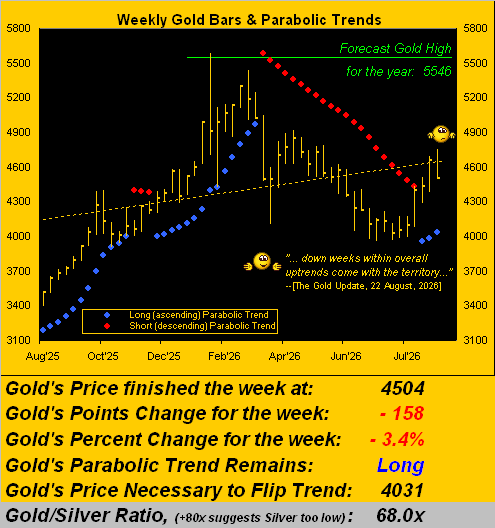
- As the USA/IRN war seems on the path to “inevitibly” re-heat, as herein oft stated, the bid for Oil shall re-elicit the bid for the Dollar, which during warring days has been Gold negative. ‘Twould be catalytic to close that gap as just shown between Gold’s price and its BEGOS Market Value. Yes, Gold has only just embarked on its new weekly parabolic Long trend; but down weeks within overall uptrends come with the territory: Gold’s previous Long trend lasted 14 weeks in which five were down; it happens.
The point is: we don’t see the new Long trend being “Short-lived”; but hardly do see it as simply uni-directionally up.
Meanwhile, trying to buck being what had recently seemed uni-directionally down is the Econ Baro. 12 metrics came into the Baro this past week, of which eight were better period-over-period, the notable standouts being July’s Building Permits and the Conference Board’s Leading (i.e. “lagging”) Economic Index, the latter having reported a positive bias for only the fourth time in the past ten months. As to the Building Permits, they beat consensus and those for June, which were also revised upward: this may be positive for August’s Housing Starts that for July missed consensus and were less than June, those therein revised lower. Thus in going to the Econ Baro, let’s cue “If I had a hammer” –[The Weavers, ’50]:
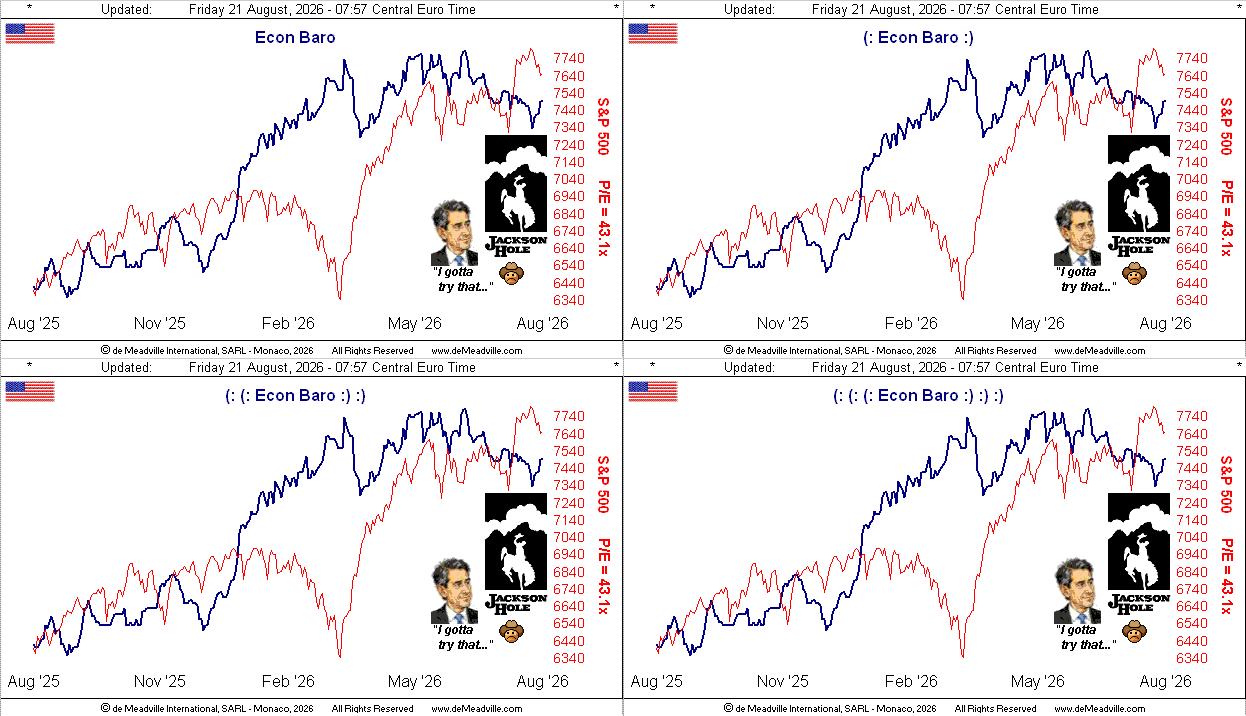
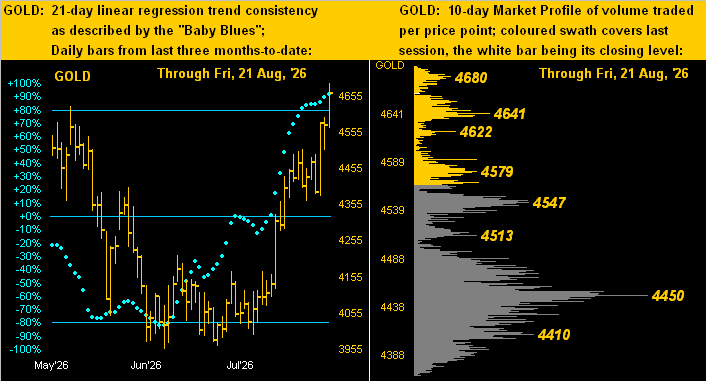
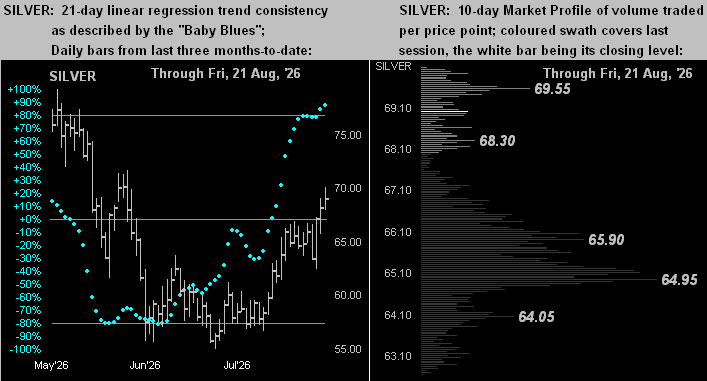
Toward wrapping, we just had the closing of Q2 Earnings Season. Specific to the S&P 500’s 503 constituents, 443 reported within the calendar season, of which 349 (79%) bettered their bottom lines from Q2 a year ago: that by percentage improvement ranks second-best across the past 12 reporting quarters. ‘Tis the good news.
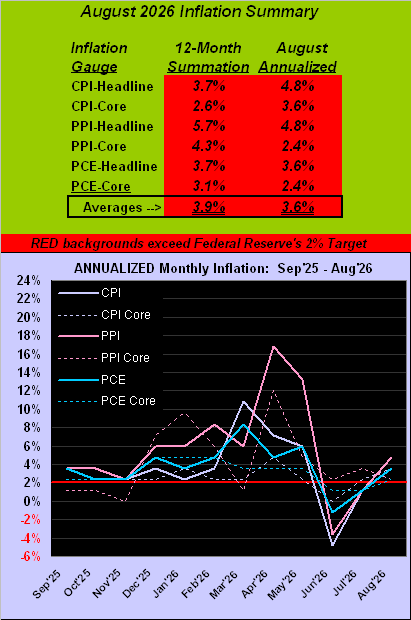
However, you regular readers therefore know the bad news: the overall level of earnings remains significantly insufficient to support an S&P yielding but 1.090% with our “live” (ttm) price/earnings ratio of now 43.1x, which in turn is +70% higher than ’twas when conceived at 25.4x back in January 2013. (For you WestPalmBeachers down there, that is mathematically suggestive of a correction in the S&P of worse than -40%). Or to reprise from “The Eiger Sanction” –[Universal, ’75] what Reiner Schöne (as Karl Freytag) exclaimed to Michael Grimm (as Anderl Meyer) and Clint Eastwood (as Jonathan Hemlock) whilst all were desperately clinging to the iconic north face: “The ice is cracking!!”
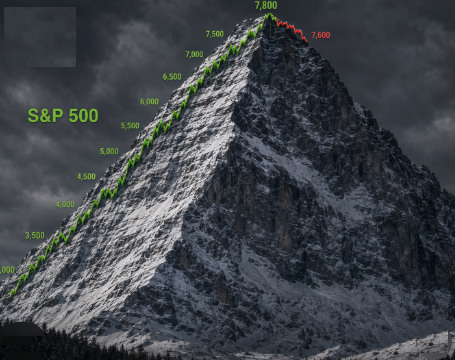
But Gold is cracklin’!!
Cheers!
…m…
www.TheGoldUpdate.com
www.deMeadville.com
and now on “X”: @deMeadvillePro
21 August 2026 – 08:40 Central Euro Time
The Euro plus the three elements of the Metals Triumvirate are presently above today’s Neutral Zones; the rest of the BEGOS Markets are within same, and volatility for the session again is light. Amongst the five primary BEGOS Markets, our best current correlation continues between Oil and the Spoo as negative; Oil’s top Market Rhythm for pure swing consistency is the 6hr Parabolics whilst for the Spoo ’tis the 1hr Parabolics; and the Spoo has slipped below its BEGOS Market Value for the first time since 31 July, suggestive of lower prices near-term: structural support for the Spoo spans from 7632 to 7324. Gold (4622) is up to its highest level since 29 May: more tomorrow in the 875th consecutive Saturday edition of The Gold Update. Nothing is due today for the Econ Baro; and ’tis the final day of Q2 Earnings Season.
20 August 2026 – 08:45 Central Euro Time
At present, we’ve both the Swiss Franc and Gold below today’s Neutral Zones; the balance of the BEGOS Markets are within same, and session volatility is light. Yesterday’s StateSide Treasury notification toward buying back longer-term maturities gave significant boosts to the currencies and metals: specifically for Gold, in real-time ’tis trading +390 points above its BEGOS Market Value; such prior extreme was in the run to last January’s record high (5586), after which price fell considerably over the ensuing months, (not that we envision a like pullback this time ’round); that said, some retrenchment whilst still maintaining the new broader weekly parabolic Long trend would be reasonable to expect, especially with indications of the war being extended such that Oil brings a bid again for the Dollar. The Econ Baro concludes its week today (Thursday) with metrics including August’s Philly Fed Index, plus July’s Leading (i.e. “lagging”) Economic Index.
19 August 2026 – 08:44 Central Euro Time
The Bond, Euro and Swiss Franc are all at present above today’s Neutral Zones; none of the other BEGOS Markets are below same, and session volatility is light-to-moderate. By Market Rhythms, leading the pack for pure swing consistency is the Spoo’s 30mn MACD: its last 10 crossings (since 11 August) have yielded an intra-signal max profit/max adversity ratio of 5.5x. Gold, having reached well-above its BEGOS Market Value after being better than +300 points (now +234 in real-time), reverted yesterday such as to fall below its most volume-dominant Market Profile supporter of 4450 as well as slip below its Market Magnet of 4393; such reversion is normal, and moreover, the new weekly parabolic Long trend remains well intact, the “out-of-range” 3955 level being this week’s reversal price. Nothing is due today for the Econ Baro, although the FOMC’s Minutes from its 28/29 July meeting come due late in the session: because the actual Policy Statements under FedHead Warsh are comparably brief, the Minutes take on more scrutiny than in prior years.
18 August 2026 – 08:48 Central Euro Time
The Bond, Euro, Silver, Copper and Spoo are presently below today’s Neutral Zones; above same is Oil, and BEGOS Markets’ volatility is pushing toward moderate. The Bond has not risen toward our 112 notion as rising yield desires continue to pressure price: we’ll continue to mind the “Baby Blues” (see Market Trends) of linreg consistency there; the Bond’s best Market Rhythm currently is (10-test basis) the 30mn Parabolics and (24-test basis) the 1hr MACD. Going ’round the Market Values horn in real-time for all five primary BEGOS components we’ve: the Bond showing as -4^27 points “low” vis-à-vis its smooth valuation line, the Euro as -0.009 points “low”, Gold as +297 points “high”, Oil as +4.97 points “high” and the Spoo as +55 points “high”. Today the Econ Baro receives a bevy of July reports encompassing Housing Starts/Permits, Ex/Im Prices, IndProd/CapUtil, and Pending Home Sales.
17 August 2026 – 08:41 Central Euro Time
We’ve the Bond, Euro, Swiss Franc, Gold, Silver, Copper and Spoo all at present above their respective Neutral Zones for today, whilst below same is Oil; session volatility for the BEGOS Markets is moderate, noting therein that Copper already has traced 100% of today’s EDTR (see Market Ranges). The Gold Updates states “Still Higher Gold Ahead” given the weekly parabolic trend having flipped from Short back to Long with potentially the 4900s in the balance on this run; but that could well get nixed should the USA/IRN war remain unresolved, (Oil and thus the Dollar then getting the bid). Our Top Three Market Rhythms for pure swing consistency at this point are (on a 10-test basis) the Bond’s 30mn Parabolics and both Gold’s daily Moneyflow and daily Price Oscillator; also (on a 24-test basis) they are the 1hr Parabolics for both the Euro and Silver, plus the Bond’s 1hr MACD. The Econ Baro’s scheduled 12 incoming metrics for this week begin with the NY State Empire and NAHB Housing Indices. And this is the final week of Q2 Earnings Season.
The Gold Update: No. 874 – (15 August 2026) – “Still Higher Gold Ahead”
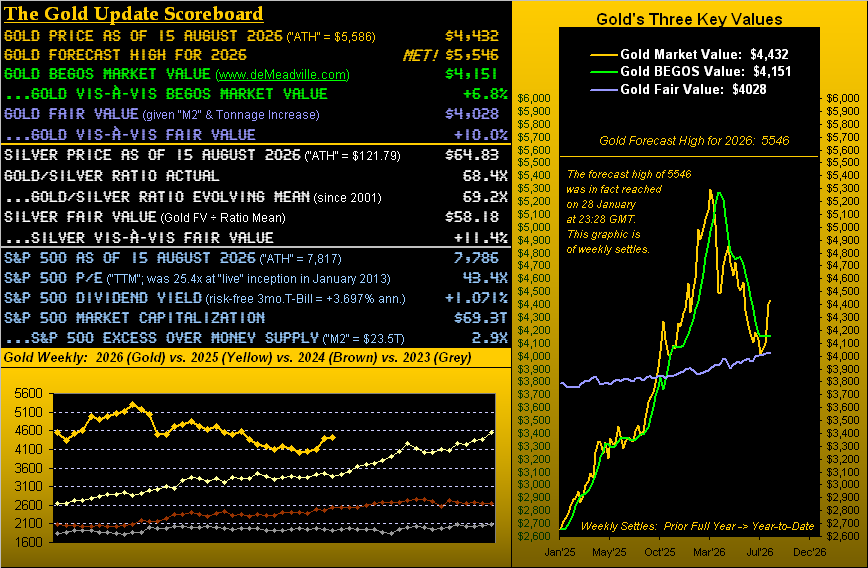
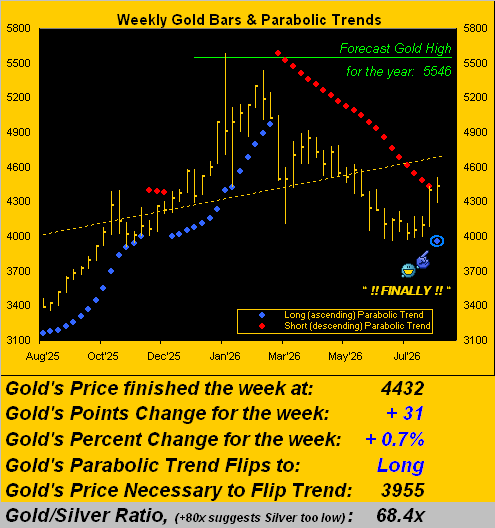
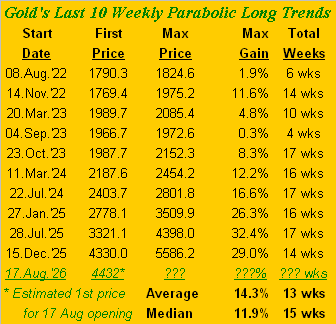
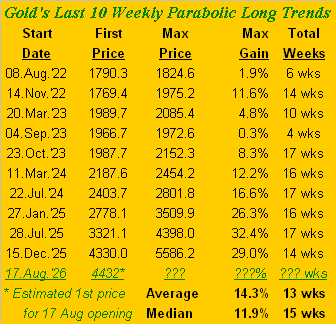
Note that list’s first five (starting during 2022-2023) pale in performance when compared to the second five (starting during 2024-2025). Moreover, the most recent Long trends have basically gone up “off the charts” such that you’ll recall our having regularly written that Gold had “gotten ahead of itself”, followed by this year’s high-to-low correction of -29.2% (from 5586 on 29 January to 3955 on 30 June). But specific to this history graphic, at the foot we’ve depicted the “Average” and “Median” maximum Gold gains of respectively 14.3% and 11.9%. Conservatively, let’s go with the latter, in which such vacuum from here at 4432 we’d reach Gold 4959 during this Long trend. ‘Course the median duration is 15 weeks, which from today would put us at this year’s StateSide Black Friday (27 November) … and between “Now and Then” –[BeaTles, ’23], the S&P 500 may suffer many-a-black day in reverting to a reasonable valuation, but with an unknown Gold implication … just sayin’.
“That is really stock market bearish, mmb…”
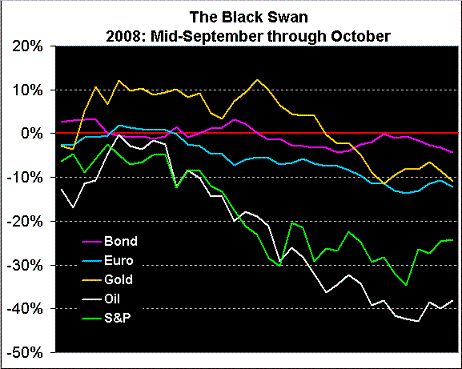
‘Tis, Squire. Barring one’s having been out on Neptune, those paying attention have read much bearishness being cited over “AI” heading to its own “DotCom” moment, (see 2000-2002). But just this past week, the otherwise children’s writing pool over at the once-mighty Barron’s produced a sobering piece entitled: “Stock Markets Beware: AI Funding Plans Have Shades of the Financial Crisis” (see 2008-2009). Think about it: a “double-whammy” repeat likened to both the DotComBomb and FinCrisis, each of which ultimately featured -50% declines for the S&P, (which today would actually get the Index back in line with the aforementioned “reasonable valuation”).
We’re only pointing this out as such “double-whammy” would likely be characterized as a “Black Swan”, during which asset prices could suffer significantly. Recall how it all began near this time in 2008:
To wrap, we’ve the Stack:
The Gold Stack (continuous contract pricing):
Gold’s All-Time Intra-Day High: 5586 (29 January 2026)
2026’s High: 5586 (29 January)
Gold’s All-Time Closing High: 5411 (28 January 2026)
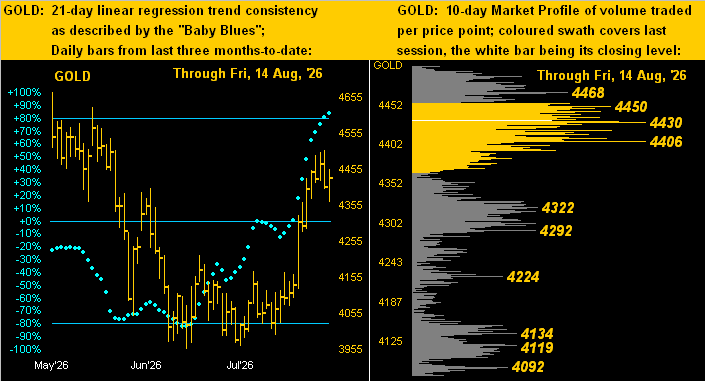
10-Session directional range: up to 4503 (from 4081) = +422 points or +10.3%
Trading Resistance: nearby Market Profile notables: 4488 / 4468 / 4450
Gold Currently: 4432, (expected daily trading range [“EDTR”]: 96 points)
Trading Support: nearby Market Profile notables: 4406 / 4322 / 4292
10-Session “volume-weighted” average price magnet: 4343
The 300-Day Moving Average: 4196 and rising
Gold’s BEGOS Market Value (from our opening “Scoreboard”): 4151
Gold’s Fair Value per Dollar Debasement, (from our opening “Scoreboard”): 4028
The Weekly Parabolic Price to flip Short: 3955
2026’s Low: 3955 (30 June)
The 2000’s Triple-Top: 2089 (07 Aug ’20); 2079 (08 Mar’22); 2085 (04 May ’23)
The Gateway to 2000: 1900+
The Final Frontier: 1800-1900
The Northern Front: 1800-1750
On Maneuvers: 1750-1579
The Floor: 1579-1466
Le Sous-sol: Sub-1466
The Support Shelf: 1454-1434
Base Camp: 1377
The 1360s Double-Top: 1369 in Apr ’18 preceded by 1362 in Sep ’17
Neverland: The Whiny 1290s
The Box: 1280-1240
In simply summary: think ’tis a good time to be holding Gold? Indeed!

Cheers!
…m…
www.TheGoldUpdate.com
www.deMeadville.com
and now on “X”: @deMeadvillePro
14 August 2026 – 08:40 Central Euro Time
The Bond is presently below its Neutral Zone for today, whilst above same is Oil; BEGOS Markets’ volatility is light. As recently noted, we’re looking for the Bond (109^13) to rise toward 112 as the “Baby Blues” of linreg consistency cleared their -80% axis (see Market Trends) and indeed continue to rise as price’s downtrend becomes less negative: with inflation somewhat cooling, the Bond can get the bid. Going ’round the Market Values horn for the five primary BEGOS components, we’ve (in real-time) the Bond -3^24 points “low” vis-à-vis its smooth valuation line (itself at 113^05), the Euro -0.011 points “low”, Gold +234 points “high”, Oil +2.39 points “high”, and the Spoo +151 points “high”. Tomorrow’s 874th consecutive Saturday edition of The Gold Update shall underscore the weekly parabolic Short trend having (after 21 weeks) flipped to Long. The Econ Baro concludes the week with August’s UofM Sentiment Survey, July’s Retail Sales, plus June’s Business Inventories. And we’ve one week remaining in Q2 Earnings Season.
13 August 2026 – 08:43 Central Euro Time
Presently, we’ve both the Bond and Oil above today’s Neutral Zones, whilst below same are all three elements of the Metals Triumvirate; session volatility for the BEGOS Markets is pushing toward moderate. The Spoo for better than a week has been in a relatively compressed trading range: indeed the EDTR (see Market Ranges) is narrowing, (85 points being today’s expected range, even as the widest actual span so far this week has been but 58 points). For the five primary BEGOS components, the best current correlation is negative between Oil and the Spoo. Both the Euro and Copper yesterday slipped below their Market Magnets, suggestive of still lower price levels near-term, albeit there is no noticeable breakdown in their “Baby Blues” (see Market Trends). And today brings wholesale inflation for the Econ Baro via July’s PPI.